
Click Surya (Sun) below to play once.




Enjoy your stay, and may your Knowledge and Wisdom Grow.
Welcome to the GAYATRI COMPENDIUM
Enjoy your stay, and may your Knowledge and Wisdom Grow.
Param Jyoti — The Source Light
“The space within the heart — that is the dwelling of the Self.
Smaller than a grain of rice, greater than the sky and all the worlds.”
— Chāndogya Upaniṣad 8.1.1-3
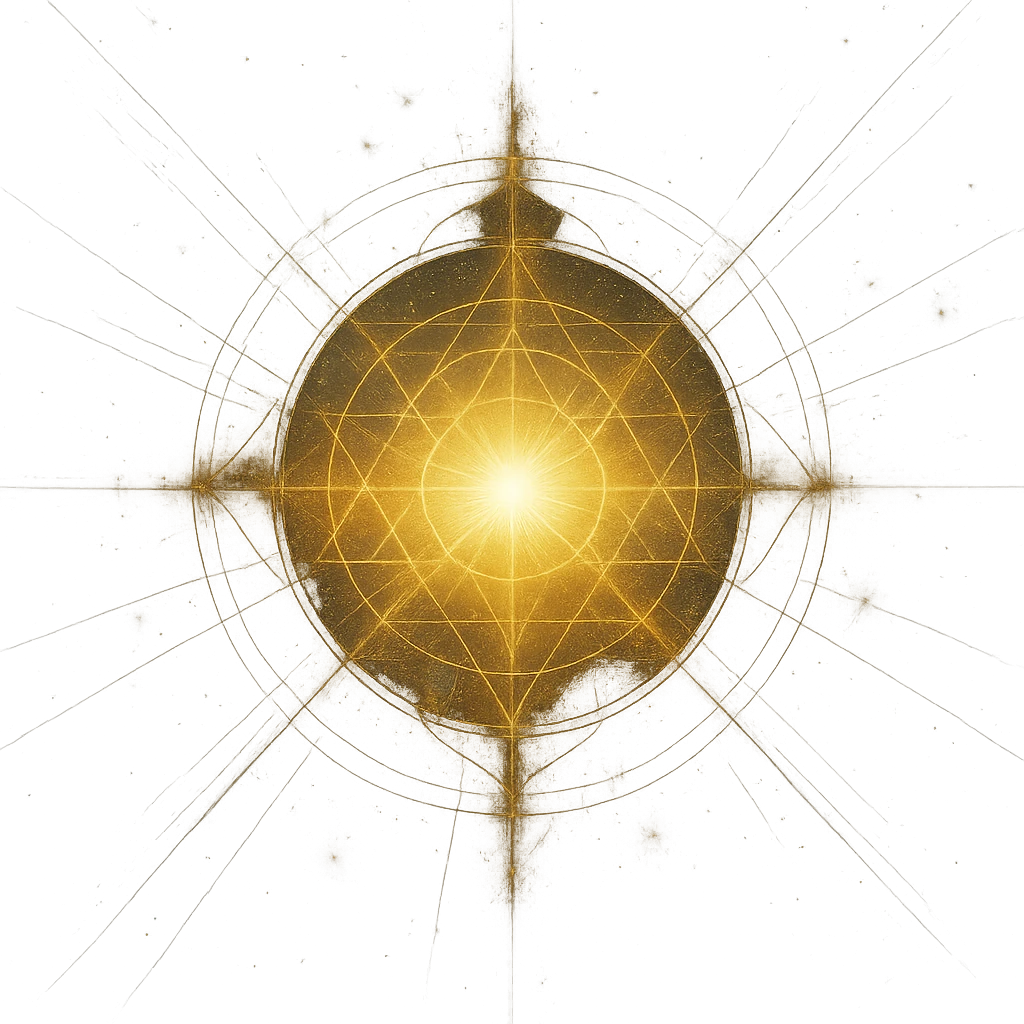
Before the first sound, before the first ray, there was only Param Jyoti — the Supreme Light.
It is not a sun, nor a star, nor any object that can be seen;
it is the light by which all seeing is possible.
It shines everywhere and nowhere, smaller than the smallest,
greater than the greatest —the still radiance hidden within every heart.
The seers of the Veda called it jyotiṣām jyotiḥ — “the Light of lights.”
This light is not born, nor does it die.
It is the awareness that beholds creation, sustains it, and finally receives it back into silence.
The Descent of Radiance
From that timeless stillness arises the first impulse to shine
— Savitur, the divine intelligence that moves even the sun.
Savitur is the will of Param Jyoti, the intention of light to know itself.
From this impulse flows Sāvitrī, the feminine current,
the luminous Shakti who gives the radiance voice and rhythm.
Her mantra-body is the Gayatrī, twenty-four syllables of pure consciousness
vibrating through the worlds.
“Tat Savitur Vareṇyam Bhargo Devasya Dhīmahi,
Dhiyo Yo Naḥ Prachodayāt.”
— Ṛg Veda 3.62.10
“We meditate upon that adorable glory of the radiant Savitur;
may he inspire our intellects.”
Through this mantra the solar consciousness becomes audible.
It moves as light through sound, descending from the formless Param Jyoti
into the pattern of creation — fire, wind, water, earth, and mind.
Every spark, every breath, every heartbeat is that same radiance refracted into life.
The Reflective Light — Chandra and the Mind
The Sun (Sūrya) is the outer face of Savitur, the visible lamp of heaven.
The Moon (Chandra) is its mirror — the mind reflecting the solar truth.
Just as the moon pulls the ocean’s tides, it draws the subtle waters of our awareness,
shaping moods, dreams, and inner tides of consciousness.
When the moon is calm and full, it reflects Savitur perfectly
— the mind becomes a clear mirror of the Self.
When restless or clouded, the reflection breaks.
Thus the rhythm of the heavens repeats within us; the macrocosm breathes through the microcosm.
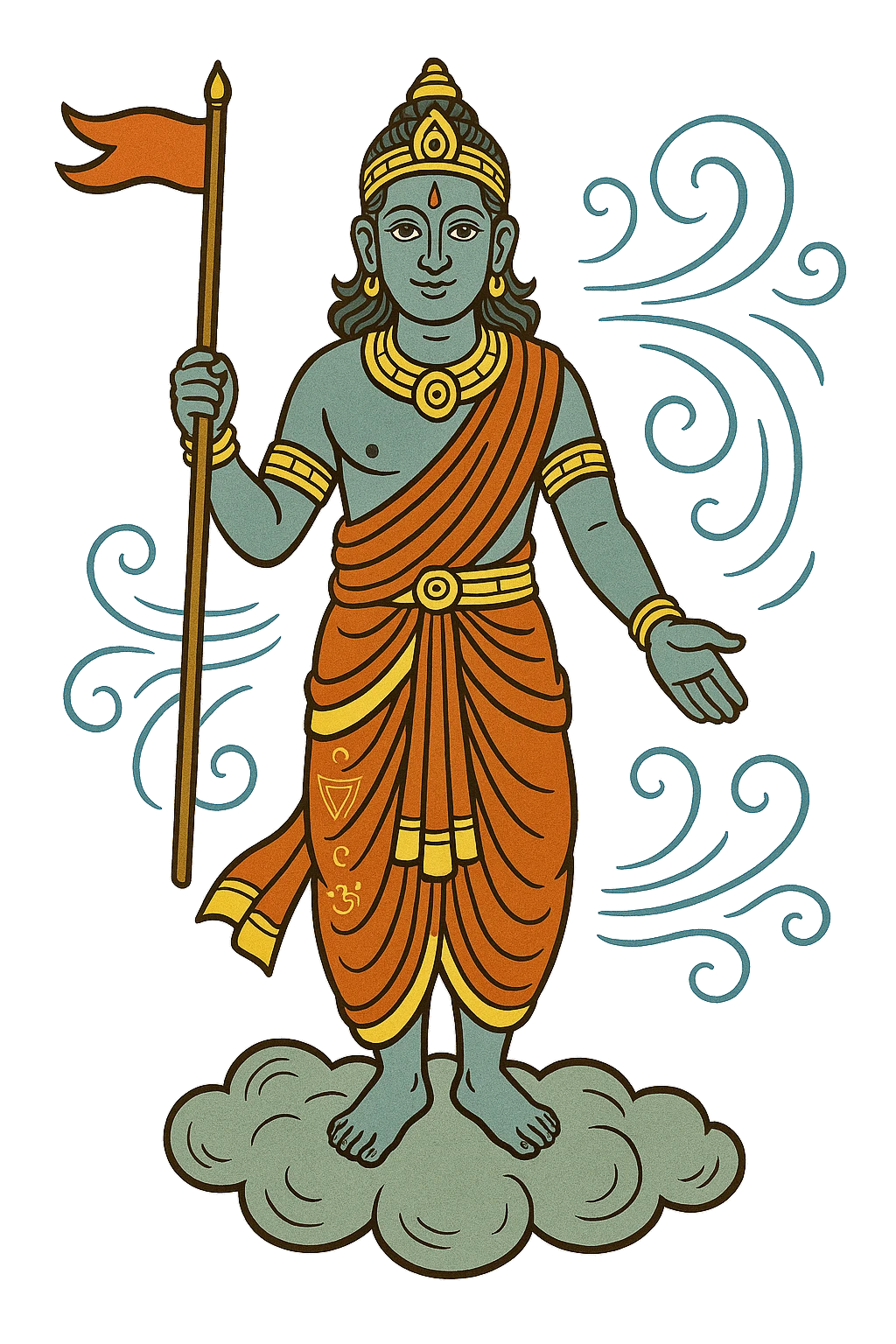
Vāyu — Wind / Breath
Between the light of Sūrya and the mirror of Chandra moves Vāyu,
the sacred wind, the motion of consciousness through space.
Outwardly, Vāyu is the wind of the worlds; inwardly, he is the breath of the Self
— the current of prāṇa that carries Gayatrī’s vibration through the body.
To feel one’s breath is to feel the motion of the cosmos,
for that same Vāyu circulates in stars, in oceans, and in the silent chamber of the heart.
Param Jyoti in the Heart
The sages spoke of the dahara ākāśa — “the small space within the heart.”
It is not a physical place but the inner sky of awareness.
Within that sky shines a minute flame, a bindu of living light.
Though it appears smaller than a mustard seed, it holds all worlds in potential.
|
Aspect |
Description |
|
Location |
Heart-lotus (hṛdaya kamala) — the seat of consciousness |
|
Form |
A point of light — smaller than the smallest |
|
Power |
Greater than the greatest — source of life and awareness |
|
Nature |
Self-luminous, formless, eternal, uncreated |
“In that heart-cave dwells the Self, radiant as a thousand suns, yet gentle as a single flame.”
— Muṇḍaka Upaniṣad 2.2.10
When we meditate upon this flame,
we discover that the light within is the same light that burns in every star,
the same awareness that pervades gods, elements, and beings.
Param Jyoti is not elsewhere — it is the consciousness through which “elsewhere” appears.
Sound and Light — Para Vāk and Param Jyoti
Creation unfolds as a twin revelation:
|
Aspect |
Formless Source |
Manifest Expression |
|
Light |
Param Jyoti |
Savitur → Sūrya |
|
Sound |
Para Vāk |
Sāvitrī → Gayatrī |
Para = the Source.
Param Jyoti = Source as Light.
Para Vāk = Source as Sound.
They are two sides of one act of creation.
The universe shines as light and sings as sound —
illumination and vibration, radiance and resonance.
Every mantra, every ray, is an echo of that original harmony.
“From Him come all breaths, all minds, all words, all worlds.”
— Bṛhad Āraṇyaka Upaniṣad 2.1.20
Continuum of Consciousness
Across all planes — causal, subtle, and physical —
this one consciousness flows as radiance.
It does not begin or end; it simply reveals itself through varying densities of light:
|
Plane |
Expression of the One Light |
|
Causal |
Param Jyoti — still, formless awareness |
|
Subtle |
Savitur — inner sun of intelligence |
|
Mental |
Sāvitrī — self-reflection, mantra vibration |
|
Vital |
Vāyu — breath, motion, prāṇa |
|
Physical |
Sūrya — outer sun, source of energy and life |
Through every level runs the same current of being —
a single ray from the eternal Source passing through many worlds.
Its brilliance does not fade with time; it only changes tone.
The future does not await it, for it is the very Now in which all past and future arise.
Contemplation
Sit in stillness and feel the breath as wind moving through the inner sky.
Sense a golden point glowing in the heart.
With each inhalation, let that light expand; with each exhalation,
let it illumine the space around you.
Realize that what shines within is the same sun that rises without.
This is the recognition of Param Jyoti —
the highest form of no-form,
the infinite appearing as the infinitesimal,
the cosmic sun residing in your own heart.
Closing Reflection
“Before sound, there was silence that shimmered — Para Vāk.
Before form, there was light that had no direction — Param Jyoti.
They are not two, but the Source remembering itself
as both song and shine.”
Everything that moves, breathes, or dreams is touched by this radiance.
It flows through gods and galaxies, through thought and breath,
through the high and the low, through you and through me.
It is the consciousness-light of all that is,
never born, never fading — the eternal Gayatrī shining through every plane of being.
Chapter 1 - Who is Gayatri?
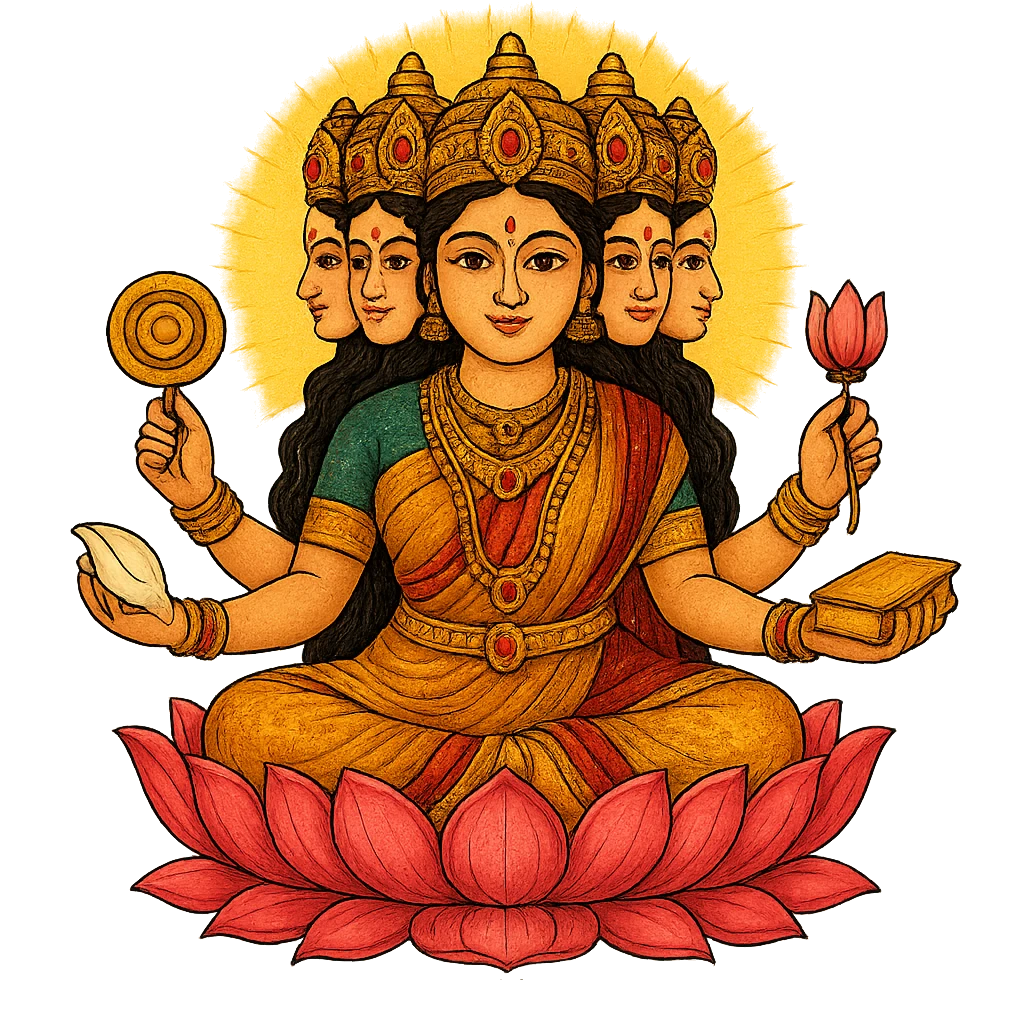
“Who is Gayatri?”
At first glance, Gayatri appears as a mantra — 24 syllables of sacred sound addressing Savitur, the divine solar being.
But soon, the practitioner discovers Gayatri is more than a mantra:
she is a goddess, a form of divine feminine consciousness, and the bridge between worlds.
Preface: The Origins of Gayatri — From Meter to Mantra to Goddess
Long before she was honored, as a goddess, Gayatri was a meter — a specific pattern of syllables used to structure the hymns of the Rig Veda.
Among these ancient invocations, one verse stands apart as the jewel of the Vedic tradition:
“Tat Savitur Vareṇyaṁ
Bhargo Devasya Dhīmahi
Dhiyo Yo Naḥ Prachodayāt”
— Rig Veda 3.62.10
This 24-syllable verse is known as the Gayatri Mantra,
addressed to Savitur, the solar deity — the divine sun that illuminates all life.
At its core, this mantra is a universal prayer for illumination.
It asks not for wealth, power, or protection, but for the awakening of the intellect (dhi)
— the highest function of consciousness.
In this simple yet profound request, the early seers expressed a yearning not just for outer light, but for inner radiance
— the light of understanding, realization, and spiritual clarity.
From Sound to Power: Gayatri as Mantra
The mantra gained prominence in the Yajur and Sama Vedas,
and was adopted as the core of daily recitation (sandhya vandanam)
for initiated Vedic practitioners. It became more than a poetic structure
— it became mantra: sacred sound capable of transforming consciousness.
Each of its 24 syllables was seen not merely as phonetic sound, but as vibration (spanda) — divine energy in seed form.
Thus began Gayatri’s transformation from meter into shakti — from pattern to power.
From Mantra to Form: Gayatri as Goddess
In later post-Vedic and Tantric periods, Gayatri was personified as a goddess,
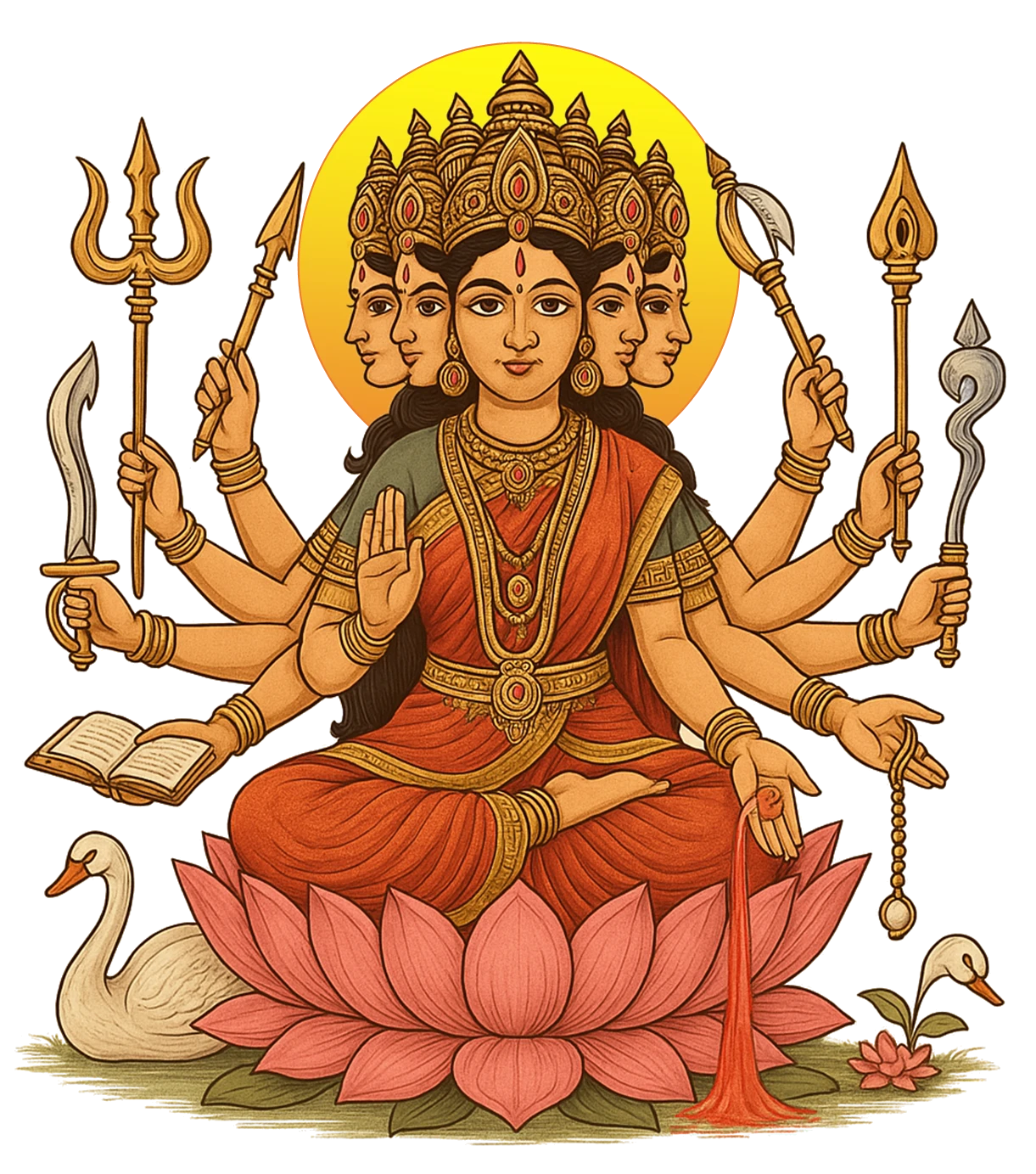
often shown with five faces and riding a swan or lion. Her five faces came to symbolize:
The five pranas (vital energies)
The five elements
The five Mahashaktis
Or the five directions of awareness
She was often considered the consort of Brahma, but in Tantric traditions,
she was identified with Tripura Sundari, Saraswati, or even the supreme Shakti herself.
|
Lineage Perspectives |
|
|
Tradition |
View of Gayatri |
|
Vedic |
A sacred meter and mantra to Savitur |
|
Vedantic |
A luminous prayer to awaken pure intellect |
|
Tantric |
A goddess of 24 powers and 5 energies |
|
Bhakti |
A divine mother, radiating compassion |
In South Indian esoteric traditions, especially among Sri Vidya and Shaakta paths, Gayatri is more than symbolic.
She is a mantric body of Shakti — one whose vibration resonates across the three worlds (bhur, bhuvah, svah).
Symbolism of Her Name
“Gaya” = life force
“Tri” = protector of the three worlds
Gayatri = “She who protects the vital force in all three worlds”
She is thus not only a mantra, a goddess, or a form of light — she is a vibrational bridge between the human and the divine.
Why Her Origins Matter
Understanding Gayatri's origins reveals her multi-layered identity:
She is the earliest mantra, yet carries Tantric dimensions
She belongs to orthodox Brahmanism, yet is revered in egalitarian Bhakti
She is formless light, yet takes five-faced form
She is a cosmic force, yet intimately lives in every breath of recitation
She stands at the very crossroads of Indian spirituality
— the place where Veda meets Tantra, ritual meets realization, and sound becomes light.
Part 1: Cosmic Foundations
Introduction to Gayatri and Divine Consciousness
The Gayatri Mantra is one of the most ancient and revered mantras of the Vedic tradition,
found in the Rigveda (Mandala 3.62.10). It is addressed to Savitur, the divine solar being,
and calls upon the highest light of the cosmos to illuminate our intellects.
But Gayatri is not only a mantra — she is a deity, a conscious force, and a living embodiment of divine light.
She is both the mantra and the intelligence behind it.
The mantra is composed of 24 syllables, each one pulsing with Shakti (divine feminine power).
These syllables correspond to goddess forms that are visualised as petals of a sacred lotus
— each carrying attributes that enhance different facets of inner awakening.
This structure creates a vibrational mandala that purifies the layers of the subtle body (koshas)
and aligns the practitioner with deeper dimensions of spiritual awareness.
Gayatri is often identified with five faces, each representing a different divine quality
— Saraswati (knowledge), Lakshmi (abundance), Durga (power),
Savitri (inspiration), and Tripura Sundari (blissful awareness).
The central face, Tripura Sundari, is especially significant:
she exists beyond the three planes of waking, dreaming, and deep sleep.
She is the Turiya state — the fourth, non-dual state of pure awareness.
In South Indian esoteric traditions, Gayatri is sometimes interpreted through the lens of Sri Vidya Tantra,
where the mantra becomes not just a prayer but a yantra — a geometric pattern of energy leading inward to the divine Self.
Reciting Gayatri becomes a journey into one's own source-light,
guided by syllabic deities that unfold like petals toward realization.
The mantra traditionally begins with three sacred words: "Om Bhur Bhuvaḥ Svaḥ" — representing the three worlds:
Earth (physical), Atmosphere (mental), and Heaven (causal).
These act as a launch point for consciousness to rise through layers of experience and enter divine light.
The core of the mantra invokes this light (Savitur),
asking it to awaken the highest faculty within — the Buddhi, or spiritual intellect.
In this way, Gayatri is the bridge between sound and silence, form and formlessness, mantra and consciousness.
She is the mother of the Vedas and the breath of wisdom itself.
She does not merely illuminate — she transforms.
Gayatri thus initiates not just a mantra recitation but a deep inner pilgrimage.
The one who chants sincerely over time becomes the mantra, vibrating with the truth it reveals:
that divine light is not out there — it is within.
“Who is Gayatri?”
At first glance, Gayatri appears as a mantra — 24 syllables of sacred sound addressing Savitur, the divine solar being.
But soon, the practitioner discovers Gayatri is more than a mantra: she is a goddess,
a form of divine feminine consciousness, and the bridge between worlds.
Her name, Gayatri, is often mistakenly thought to derive from “tri” meaning three goddesses.
In truth, it refers to the three worlds she presides over: Bhur (earth), Bhuvah (atmosphere), and Svah (heaven).
She is the protector of life (gaya) across these planes.
Yet, Gayatri is also more than one face.
In south Indian Tantra tradition, She is said to have five faces, representing the five energies or aspects of Shakti:
Brahmi, Vaishnavi, Maheshwari, Durga, and Saraswati.
Her 24 syllables are also considered to be 24 divine powers,
each a goddess in her own right — representing the unfolding of creation and consciousness.
But these are not separate goddesses.
In Tantra, all multiplicity is a reflection of unity.
The many names are the many waves of One ocean.
So then — who is that ocean?
The Ten Mahavidyas: Faces of the One
In Shakta Tantra, the Ten Mahavidyas — or “Great Wisdom Goddesses” — are ten aspects of the Supreme Goddess.
Each is a complete and independent expression of cosmic power, representing a different facet of divine truth.
Kali – Time, death, transformation, the void
Tara – Guidance, protection, and sound
Tripura Sundari (Shodashi) – Beauty, perfection, and bliss
Bhuvaneshwari – The Queen of the Worlds, space and creation
Bhairavi – Fierce discipline and spiritual intensity
Chhinnamasta – Self-sacrifice and transcendence of ego
Dhumavati – The smoky one, emptiness, and dissolution
Bagalamukhi – Stopping power, silence, and control
Matangi – Outcast wisdom, inner voice, and art
Kamala – Prosperity, grace, and material abundance
Each Mahavidya is both her own path, and a mirror of the whole.
Who Is Supreme? The Paradox of Primacy
In some traditions — especially Kali Kula (the lineage of Kali)
— it is said that all other goddesses emerge from Kali.
She is the source, the formless void from which even time and space arise.
In this view:
Bhuvaneshwari is a later expression of form
Tripura is a refinement of manifestation
But in other traditions — notably Sri Vidya
— the view is reversed:
Tripura Sundari is the supreme Devi
Bhuvaneshwari is her cosmic body — the womb of space
Kali is her power of time and dissolution
From this lens, Bhuvaneshwari is not just a Mahavidya.
She is the Primordial Matrix
— the space within which all others arise.
Kali is born from her as Time, Tripura is her face as Beauty,
and Gayatri is her mantra-body that stretches across the worlds.
This is not contradiction. It is Tantra’s radical inclusivity.
Each goddess is supreme — depending on where you stand.
The One in Many: Bhuvaneshwari as the Womb
The word Bhuvaneshwari means “Queen (Ishwari) of the Worlds (Bhuvana).”
She is the cosmic space, the matrix in which all tattvas unfold,
where sound arises, and from which time, energy, and mind are born.
In advanced Tantric cosmology:
Shiva is pure awareness
Shakti is dynamic power
Bhuvaneshwari is their unified field — the sacred container of all reality
From her arise:
Kala – Time, manifesting as Kali
Spanda – Vibration, as sound and mantra
Tattvas – The principles of existence
Deities – Forms through which humans approach her
Gayatri, in this view, is a sonic portal — a mantra that descends from Bhuvaneshwari to guide the soul back to her.
Summary: Which Devi is Primary?
|
Perspective |
Supreme Goddess Seen As |
Why? |
|
Kali Kula (Void-first) |
Kali |
Time, death, formlessness, blackness |
|
Sri Vidya (Beauty-first) |
Tripura Sundari |
Conscious embodiment, bliss, union |
|
Space-first Tantras |
Bhuvaneshwari |
She is the container for all others |
Gayatri is a thread through them all — her 24 syllables arise from the void of Kali,
shine through the light of Tripura, and echo in the vastness of Bhuvaneshwari.
Final Insight
Whether one sees Kali as the source, or Bhuvaneshwari as the matrix, or Tripura as the goal, the truth is the same:
The Goddess is One. She is many. She is you.
She is the formless that becomes form.
The silence that becomes syllables.
The void that sings. In honoring her many faces — Kali, Tripura, Bhuvaneshwari, Gayatri — we do not divide the Divine.
We learn to listen with more ears, see with more eyes, and walk the path with more wonder.
Chapter 2 - The 24 Syllables of Gayatri
The 24 Syllables of Gayatri & Their Goddesses

The Gāyatrī Mantra is one of the most profound and multidimensional mantras in all of Vedic and Tantric spirituality.
Its power is not simply in the sound, but in the structure, symbolism, and subtle resonance it encodes.
The mantra unfolds across 24 syllables, arranged in three lines of eight syllables each.
Yet, in the Tantric and Southern Indian traditions, there exists a more esoteric layer
— each of the 24 syllables is personified as a goddess,
forming a sacred wheel or mandala of divine feminine intelligence.
This represents not just linguistic sound, but Shakti in seed form:
24 pulsations of energy, each acting as a mirror of consciousness.
Two Systems of Syllabic Understanding
There are two major systems that explain the structure of Gayatri’s 24 syllables.
Understanding both offers insight into how different traditions preserve and apply her wisdom:
- Vedic/North Indian (Chandas-based)
This is the metrical structure from the Ṛg Veda, where the mantra is recited in triplets of 8 syllables,
known as Gāyatrī Chandas. It is:
Recited metrically: 8-8-8 = 24 syllables
Meant for precision, rhythm, and clarity in yajña and meditation
No deity mapping per syllable, but symbolic power is encoded in the sounds
Textual Breakdown:
ॐ (not counted among the 24 syllables)
भूर् भुवः स्वः (maha-vyāhṛtis – not part of core syllables)
तत् सवितुर् वरेण्यं (8)
भर्गो देवस्य धीमहि (8)
धियो यो नः प्रचोदयात् (8)
This is the Ṛgvedic lineage, preserved in the North, temple rituals, and priestly Vedic chanting.
- Tantric/South Indian (Deity-based Mandala)
Here, each of the 24 sound pulses of the mantra (including Om as the 24th)
is linked to a specific Devi, a quality of Shakti.
Used in visualization, inner ritual, yantra work
Includes Om as the 24th syllable
Seen in Śrīvidyā, South Indian temples, and esoteric tantric manuals
This version is not at odds with the Vedic view—it is a subtle expansion,
applying mantra as living power, not just poetic meter.
The Sacred Mandala of the 24 Goddesses
In Tantric cosmology, the 24 syllables of Gāyatrī are arranged in a three-ringed lotus, each with 8 petals, surrounding a radiant center.
This center holds the Maha-vyāhṛtis: Om, Bhur, Bhuvaḥ, Svaḥ
— representing the three worlds (physical, subtle, causal) and Om as the seed of all vibration.
The petals extend out like spokes in a wheel, each with a syllable, a goddess, and a divine attribute.
Mapping the 24 Syllables to the Goddesses
|
No. |
Syllable |
Goddess |
Power / Symbolism |
|
1 |
Tat |
Vāmā |
Creative Will |
|
2 |
Sa |
Jyeṣṭhā |
Primordial Order |
|
3 |
Vi |
Raudrī |
Fierce Purification |
|
4 |
Tu |
Kālī |
Time and Dissolution |
|
5 |
Var |
Balā |
Vitality and Youthful Strength |
|
6 |
Re |
Sarasvatī |
Speech and Wisdom |
|
7 |
Ṇyaṁ |
Lakṣmī |
Harmony and Abundance |
|
8 |
Bhar |
Kāmeśvarī |
Fulfillment and Desire |
|
9 |
Go |
Bhagamālinī |
Divine Offering and Completion |
|
10 |
De |
Citrā |
Inner Vision and Radiance |
|
11 |
Vas |
Tripura Sundarī |
Supreme Bliss and Grace |
|
12 |
Ya |
Chinnamastā |
Self-Sacrifice and Ego Transcendence |
|
13 |
Dhī |
Bhairavī |
Inner Fire and Intelligence |
|
14 |
Ma |
Dūmāvatī |
Void and Wisdom of Absence |
|
15 |
Hi |
Bagalāmukhī |
Control over Speech and Action |
|
16 |
Dhi |
Mātangī |
Inner Expression and Tantric Wisdom |
|
17 |
Yo |
Rāja Mātangī |
Sovereignty and Mastery |
|
18 |
Yo |
Sundarī |
Divine Beauty and Reflection |
|
19 |
Na |
Tārā |
Liberation Through Sound |
|
20 |
Pra |
Kubjikā |
Coiled Kundalinī Force |
|
21 |
Cho |
Annapūrṇā |
Nourishment and Inner Fullness |
|
22 |
Da |
Sundarī |
Joy and Sensual Embodiment |
|
23 |
Yāt |
Mahālakṣmī |
Spiritual Abundance |
|
24 |
Om |
Gāyatrī Devi |
Unifying Light of Consciousness |
Each syllable is not simply a sound but a key that unlocks a layer of divine feminine intelligence.
The Gayatri Mandala: Visualization & Ritual
In Tantric sādhanā (practice), the Gayatri Mandala is visualized during mantra japa or dhyāna. Here’s how it unfolds:
Step 1: Visualize a central lotus with 4 syllables: Om Bhūr Bhuvaḥ Svaḥ
Step 2: Visualize 3 concentric lotus rings, each with 8 petals
Step 3: On each petal, place the Sanskrit syllable, its Devi, and attribute
Step 4: Begin mantra repetition (japa), vibrating each petal, circling the mandala, awakening all 24 forces
This creates a circuit of Shakti — energy that moves from outer awareness to inner realization.
This is not merely visualization — it becomes a yantra in the mind, an inner temple of sound.
In time, the boundaries between syllable, goddess, and self dissolve, leaving only radiant awareness.
Tantric vs Vedic Breakdown – Side-by-Side
|
Tradition |
Focus |
Structure |
Usage |
|
Vedic/North |
Meter (Chandas), Ritual Precision |
8-8-8 syllables |
Vedic yajña, recitation |
|
Tantric/South |
Syllables = Goddesses(Śakti) |
24 syllables (incl. Om) |
Inner rituals, śakti, sādhanā |
Note: The Vedic mantra often excludes "Om" from its syllabic count (as it is considered a mahā-prāṇa seed sound),
while Tantric traditions count "Om" as the 24th syllable to represent totality and the unifying source.
Inner Experience of the 24 Syllables
When deeply engaged, the 24 syllables act like keys unlocking inner chambers of:
Prāṇa (energy movement)
Jñāna (direct wisdom)
Bhāva (devotional feeling)
Over time, mantra repetition (japa) becomes reflexive, meaning:
The mantra recites itself
Each syllable echoes in the nāḍīs (subtle channels)
Each goddess becomes an aspect of your inner self
Mantra Siddhi (union with the sound) begins to dawn
Practice Suggestions
1. Nyāsa Practice:
Place each syllable on your body in a specific pattern (e.g., Tat on forehead, Sa on throat, etc.) — embodying the mandala.
2. Lotus Visualization:
Before meditation, visualize the 3-ringed lotus and chant one syllable per petal, breathing through the heart.
3. Japa Mala Circuit:
Chant 24 syllables slowly, bead by bead, assigning one goddess per syllable. Repeat 108 cycles.
4. Shadow & Light Work:
Pair each syllable/goddess with emotional alchemy (e.g., Dhī – Bhairavī for burning anger, Ma – Dūmāvatī for grief work).
Closing Reflection
The 24 syllables of Gāyatrī are not just linguistic elements.
They are the architecture of consciousness, sculpted in sound.
To chant Gāyatrī is to enter a divine geometry — a mandala where each syllable is a step,
each goddess a doorway, and each breath a return to the center.
Gāyatrī is the divine feminine encoded in vibration.
She does not demand belief.
She resonates, and if you let her, she reconfigures the soul.
chapter 3 -Tripura Sundarī and Bhuvaneshwari
Tripura Sundari and the Turiya State
.webp)
In the Gayatri Mantra, Tripura Sundarī is not explicitly named, but she is ever-present.
Especially in the culminating phrase:
धियो यो नः प्रचोदयात्
dhiyo yo naḥ pracodayāt
May That awaken our intellect.
She is the “That” — the tat — that awakens the buddhi, the intuitive faculty.
She is the inner light that makes realization possible, and the bliss that makes realization worth pursuing.
As the center of the Gayatri Mandala, she is:
The bindu in the Śrī Yantra
The flame in the lamp
The still point within all motion
While Kali tears ego apart, and Chinnamasta severs the head,
Tripura Sundarī dissolves illusion through sweetness.
She seduces the soul, not into passion, but into awakening.
Her Symbols and Their Secrets
Every object associated with Tripura Sundarī is a teaching tool:
|
Symbol |
Meaning |
|
Red Lotus |
Awakening of inner power with love (Anāhata chakra) |
|
Sugarcane Bow |
Mind directed by love, not aggression |
|
Five Flower Arrows |
Control over the five senses through beauty |
|
Noose (Pāśa) |
Power to draw the seeker toward truth |
|
Goad (Aṅkuśa) |
Power to release one from bondage when ripe |
|
Red Silk Garment |
The blissful sensuality of embodied awareness |
|
Bindi or Bindu |
Point of origin — source of creation and dissolution |
Unlike deities who conquer through terror or austerity,
Tripura Sundarī conquers the seeker by offering divine delight
— a bliss that surpasses sensual pleasure and arises from simple being.
Śrī Chakra: The Geometric Form of Tripura
The Śrī Yantra or Śrī Chakra is her sacred diagram — the map of consciousness in geometric form. It has:
9 interlocking triangles (4 upward, 5 downward) = union of Shiva & Shakti
43 total angles = cosmos in motion
Bindu at center = Tripura Sundarī herself, silent and radiant
When meditated upon, the Śrī Chakra draws awareness inward.
Each triangle and circle is a layer of perception, and the journey to the center mirrors the soul’s journey back to the Self.
She is Not an Escape — But a Revelation
Tripura Sundarī does not require renunciation of the world. She teaches that the world is sacred — when seen rightly.
She doesn’t remove form — she makes you see its true nature.
She doesn’t suppress desire — she purifies and redirects it.
She doesn’t require celibacy or silence — she calls for awareness in motion, and love infused with consciousness.
In her vision, the mundane becomes divine.
Eating, walking, loving — all become acts of worship when Turīya awareness pervades them.
Practices to Access Her Wisdom
To awaken Tripura Sundarī is to awaken your own center.
1.Śrī Vidyā Japa
Recite her root mantra:
Aim Kleem Sauḥ
or the 15-syllable mantra (Pañcadaśī) as received from a Guru
This gradually refines the mind to match her vibration.
2.Bīja Syllable Alignment
Place each Gayatri syllable in the petals of your inner lotus, with Tripura at the center.
Visualize her as radiant, seated in the heart, directing awareness.
3.Bindu Meditation
Sit in stillness. Visualize a single point of red light in your heart or crown.
Let all thought dissolve into it. Remain.
4.Beauty Awareness
Walk slowly, observing beauty everywhere — a leaf, a shadow, a silence.
Feel her in everything beautiful and serene.
Tripura Sundarī and the Path of Return
In advanced Śrī Vidyā, the external rituals fall away. All that remains is:
The bindu — the still center
The awareness that sees everything
The bliss of not needing to seek anymore
Turīya becomes not a state you reach in meditation, but your new baseline — calm, sweet, clear, ever-present.
This is Tripura’s gift:
To show you that all you seek is already here, waiting to be seen through the eyes of awakened presence.
“She lives in the breath, in the mantra, in the moment.
She does not hide from the world — she is the world, seen rightly.”
Summary Insights
Tripura Sundarī is the soul of Gayatri, the central flame in the mantra’s geometry.
She is not transcendence above the world, but awakening within it.
Turīya, her domain, is the witness behind all experience.
Through her, mantra becomes meditation, yantra becomes path, and beauty becomes truth.
To realize her is to become centered, effortless, and free — while still living, loving, and creating.
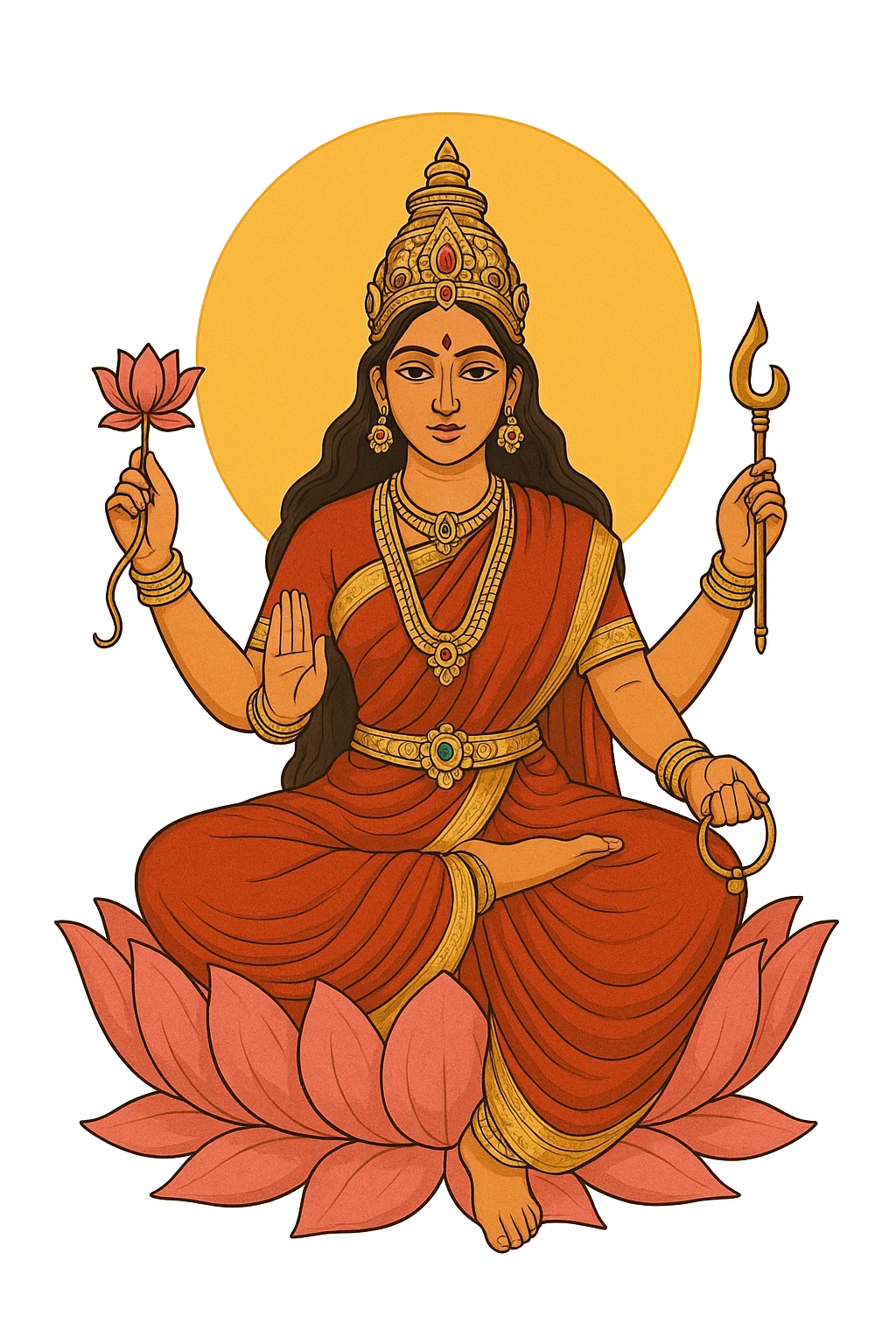
Bhuvaneshwari – The Cosmic Matrix
In the vast landscape of divine archetypes, Bhuvaneshwari (भुवनेश्वरी) reigns as the Queen of Space,
the Empress of all that exists, appears, dissolves, and arises again.
Her name derives from "Bhuvana" (worlds) and "Ishwari" (goddess, ruler), denoting Sovereign of the Worlds
— not just the physical realms, but every plane of reality, inner and outer, gross and subtle.
Bhuvaneshwari is not merely the container of the cosmos
— she is the cosmos itself, in its most subtle form.
She is space as consciousness, not as geometry or void,
but as the eternal, vibrating, intelligent medium within which all things unfold.
Tantric Understanding: Ākāśa as Womb of Existence
In Tantric cosmology, Bhuvaneshwari is identified with the element Ākāśa
— not the physical vacuum of modern science,
but a subtle etheric field from which all form emerges.
She is the womb before form, the canvas before color, the silence before mantra.
Where other goddesses express power through movement, destruction, fire, or time,
Bhuvaneshwari’s strength lies in her vastness.
She does not push or burn — she includes. She is the field in which even divinity appears.
This makes her one of the most subtle and sublime of the Mahāvidyās, the Ten Great Wisdom Goddesses.
While Kālī consumes time, and Tripura Sundarī seduces the seeker into bliss,
Bhuvaneshwari simply is — holding all things without judgment, without agenda.
Bhuvaneshwari in the Gayatri Tradition
In the Gayatri Mandala, Bhuvaneshwari is the etheric base upon which mantra, light, and realization can occur.
Gayatri is sound, Tripura Sundarī is blissful awareness, but Bhuvaneshwari is the space that makes both possible.
Every mantra arises in space.
Every vibration travels through space.
Every realization happens in awareness, which is inner space.
Thus, Bhuvaneshwari is the Mother of the Mantra, the goddess behind all other goddesses,
the silent witness whose vastness allows Gayatri’s fire to shine.
She is also associated with the fourth syllable of the Shiva Panchākṣarī Mantra
— "ॐ नमः शिवाय" — specifically, the syllable “Ya”,
which corresponds to ether (ākāśa) in the elemental model.
This links her not only to form, but to transcendence
— for space is the last element before return to formless Brahman.
Iconography and Inner Symbols
In traditional images, Bhuvaneshwari is shown:
Seated on a lotus, symbol of universal openness
Holding a noose (pāśa) and goad (aṅkuśa) — representing control over the wandering mind and karmic patterns
Gesturing with abhaya mudrā (protection) and varada mudrā (blessing) — showing her nourishing, inclusive nature
Her face is calm, radiant, expansive — a mirror of inner stillness
Her color is often red or golden, symbolizing vitality infused with infinite space.
But her greatest symbol is space itself. Not the sky, not emptiness
— but awareness so vast, all arises within it without strain.
Bhuvaneshwari and the Nature of Consciousness
From a non-dual perspective, Bhuvaneshwari represents Consciousness in its uncontracted state
— before identity, before mental construction, before even “I am.”
She is pre-reflective awareness, the field in which Shiva (pure witnessing)
and Shakti (dynamic energy) appear.
She is not a deity separate from you.
She is you — the vastness behind your thoughts, the container of emotion,
the openness you feel when you release resistance.
To realize Bhuvaneshwari is to come into non-grasping spaciousness.
Meditation deepens not by effort but by softening, by resting in the field where nothing needs to be changed.
Bhuvaneshwari and Sacred Space
In the act of consecration, whether of a temple, a home altar, or even a body,
it is Bhuvaneshwari who is invoked to rearrange space.
Her domain is Akasha, and with mantra, one calls her to:
Open the subtle field
Clear residual vibrations
Establish a coherent, radiant energetic structure
Thus, any ritual, puja, or meditation begins with aligning the space through her — often unconsciously.
Her presence is felt when a room suddenly becomes quiet, clear, and filled with peace, even without visible change.
Practices to Realise Her
1.Spacious Awareness Meditation
Sit silently, and instead of focusing on breath or mantra, focus on the space in which thoughts arise.
Ask: Who is noticing? Where is this happening?
Let your awareness dissolve into its own field.
2.Akasha Visualisation
Visualize yourself sitting in infinite sky, your body dissolving into light particles, then into nothing.
Let all inner constriction expand and release.
3.Mantra for Bhuvaneshwari
Chant:
ॐ श्रीं ह्रीं क्लीं ऐं श्रीं भूवनेश्वर्यै नमः
Om Shrīm Hrīm Klīm Aim Shrīm Bhuvaneshwaryai Namaḥ
Let the mantra be felt as vibration expanding through all layers of your being.
4.Consecration Ritual
Before mantra practice, light a lamp and declare:
“Let this space be sacred. Let it hold the divine.”
Then chant, and feel her presence infuse the room.
Bhuvaneshwari vs Other Goddesses
|
Goddess |
Function |
Mode |
|
Kali |
Destroys ego/time |
Fierce |
|
Tripura Sundarī |
Seduces to stillness |
Blissful |
|
Dhumavati |
Reveals the void |
Withdrawing |
|
Bhuvaneshwari |
Contains all of the above |
Embracing |
Where others act, Bhuvaneshwari allows.
Where others shine, Bhuvaneshwari lets light shine.
Where others break form, she holds the space in which form arises and dissolves.
The Sky Behind All Things
To merge with Bhuvaneshwari is to realize that everything arises within you.
Your joy, your sadness, your breath, your silence — all take place in space, and you are that space.
There is no pushing, no chasing, no resisting.
Just openness.
And from that openness, life flows in perfect rhythm.
“You are the sky. Everything else is just weather.”
— Buddhist proverb, echoing the essence of Bhuvaneshwari
Final Reflection
Bhuvaneshwari is not a form — she is the possibility of all forms.
She is the invisible support, the Mother Womb, the matrix of manifest and unmanifest.
She doesn’t teach by words, but by presence.
She doesn’t demand purity, only surrender into vastness.
To realize her is to find that the divine has never been separate,
and that within the field of space, everything is already whole.
Chapter 4 - Shiva,Shakti, Kali and Kala
The Dance of Consciousness – Shiva, Shakti, and the Path Through Ego
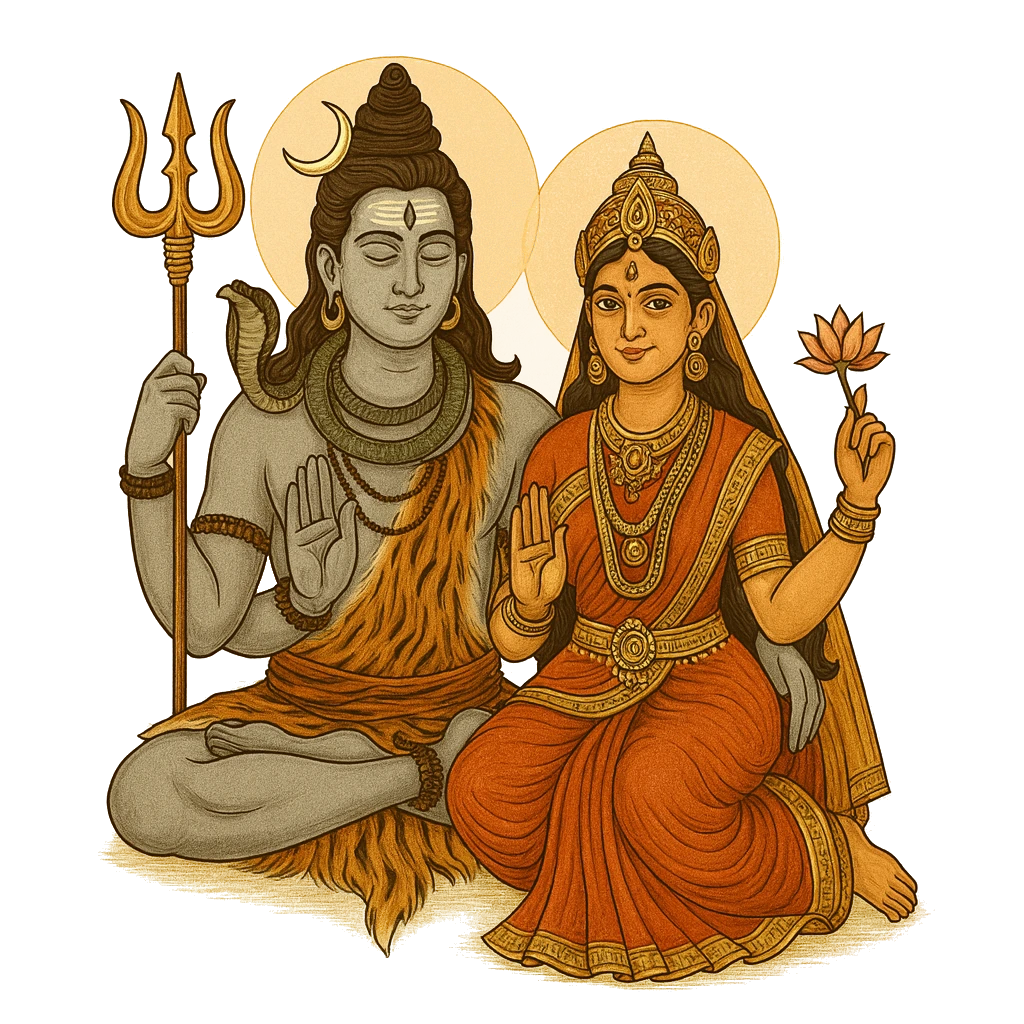
At the heart of all yogic and tantric cosmology lies a profound mystery — the mystery of duality within unity.
The concepts of Shiva and Shakti, though often portrayed as masculine and feminine deities,
are not separate personalities, but expressions of the two poles of existence itself.
This chapter delves deeply into the essence of consciousness (Shiva), its expressive power (Shakti),
and how their interplay not only creates the universe but also becomes the very path through which we transcend it.
Shiva – The Eternal Witness
Shiva, in the highest understanding, is pure consciousness
— the silent, changeless, attributeless reality that underlies all phenomena.
He is not the doer, not the actor, but the witness behind the play.
In meditation, this is the aspect of the self that watches thoughts come and go,
emotions rise and fall, sensations flicker and dissolve — yet remains untouched.
This state of witnessing is called sakshi bhava in Vedantic and yogic practice.
It is the seat of liberation, because the moment one abides as the witness, one ceases to be entangled in the story of the mind.
Shiva, in this context, is the axis of stillness within the cyclone of activity.
Symbolically, Shiva is depicted as an ascetic seated in deep meditation on Mount Kailash,
eyes half closed, absorbed in transcendental stillness.
Yet he is also the cosmic dancer, Nataraja, whose dance of creation and destruction happens within the arena of pure awareness.
This is the paradox: Shiva is both unmoving and the pulse of all motion.
Shakti – The Creative Pulse of Reality
Shakti is the dynamic energy of Shiva.
She is not separate from him — she is his power to know, to create, to feel, to love, to destroy.
Just as fire and heat cannot be separated, nor the sun and its light, so too Shiva and Shakti are one.
She appears as:
The urge to evolve
The instinct to love
The will to act
The capacity to know
Wherever there is form, sensation, thought, time, movement, life, there is Shakti.
In tantric practice, every movement of awareness into expression is Shakti.
This includes desire (Kāmā), will (Icchā), knowledge (Jñāna), action (Kriyā), and bliss (Ānanda).
All of these are Mahāśaktis — great powers through which the universe becomes manifest and through which the practitioner returns to source.
Ego, Liberation, and the Role of the Goddess
Spiritual liberation does not occur by escaping the world, but by seeing through its illusion and embracing its divinity.
The ego (ahaṁkāra) is the structure of personal identity
— Useful for functioning, but a veil when believed to be the true self.
Here, the goddess takes a fierce and transformative role:
Tripura Sundarī — seduces the ego into surrender through beauty and bliss.
She is the reflection of consciousness in the mirror of creation.
Kālī — cuts through ignorance with her sword of time and truth.
She devours false identity and forces one to face the void.
Chinnamastā — decapitates herself, feeding her attendants with her own blood.
This symbolizes the cutting of mental constructs to nourish deeper awareness.
Dhūmāvatī — the widow goddess who strips away all attachments.
She reveals wisdom not through fullness but through absence.
These are not merely mythological figures — they are forces within the psyche.
When one sits in meditation and fear arises, Kālī has arrived.
When all mental constructs dissolve in emptiness, Dhūmāvatī has entered.
When desire loses its grip, Tripura Sundarī smiles.
The Inner Temple: Meru, the Heart, and the Union
In subtle body practices, the human body is a temple. The spine is Meru,
the cosmic axis; the chakras are temples; the heart is the altar.
Shiva resides in the sahasrāra (crown) as pure consciousness.
Shakti resides in the mūlādhāra (root) as Kuṇḍalinī, coiled and waiting.
Through practice (sādhanā), mantra, and breath, Shakti rises.
When she reaches Shiva, union (yoga) occurs — not a merging of two,
but the realization that the two were never separate.
This union is the meaning of Tripura Sundarī, the goddess of the three cities
— waking, dreaming, deep sleep — who reigns in the fourth,
Turīya, the transcendent awareness behind all states.
Mantra practice, especially Gayatri, supports this by vibrating along the spine,
awakening centers of power, and aligning individual awareness with cosmic rhythm.
Practices for Integrating Shiva and Shakti
Silent Witness Meditation
Sit in stillness, observe without interference. Rest in Shiva.
Mantric Embodiment of Shakti
Chant bīja mantras like HRĪM, KRĪM, ŚRĪM. Feel their energy in the body.
Breath-Based Integration
Inhale with the awareness of rising Shakti.
Exhale into the stillness of Shiva.
Visualizing Inner Temple
See the spine as a column of light.
Invite both energies to dance within.
Conclusion: Beyond Polarity
Shiva and Shakti are not separate — they are complementary mirrors of the Absolute.
Their dance is existence itself.
To walk the path of Gayatri is to awaken both:
The stillness that watches
The vibration that sings
When these are known within, the ego dissolves, the temple awakens, and the Self remembers Itself.
In that moment, the mantra no longer needs to be spoken. It pulses from within.
That is the state beyond doing, beyond striving, beyond name — the pure state of being.
That is Shiva-Shakti in union. That is liberation.
Kali and Kala – The Goddess of Time and Transformation
She who devours illusion, fear, and time itself.
.webp)
To the uninitiated, Kālī appears terrifying — black skin, red tongue, garland of skulls,
dancing in cremation grounds, wielding weapons and severed heads.
But to those walking the inner path, she is not a destroyer in the violent sense
— she is the fierce clarity of truth, the liberating force that cuts through all illusion.
Her name derives from the Sanskrit root "kal", meaning both "time" and "black".
She is the force of time (Kāla) as it arises from the timeless.
She is black not as absence, but as that which contains all colors
— all possibilities, all forms, all endings and beginnings.
In the Tantric tradition, Kali is the mother of awakening, not through comfort or serenity,
but through raw truth, surrender, and transformation.
Kāla: The Birth of Time from the Timeless
Kāla, or Time, emerges from the moment the universe differentiates from the undivided wholeness of Bhuvaneshwari
— the Queen of Space. She is Akāla — beyond time.
But the moment motion begins within space, time is born.
This first pulse of movement is Kali’s breath.
Kāla is not linear in Tantra. It is cyclical, spiral, rhythmic.
Birth, death, decay, transformation — all are faces of Kali
She is the devourer of time — yet she is its womb as well
“Kāli is not death. She is what remains when all that is false has died.”
In this way, she is not simply “Goddess of Death,”
but the passage through which time reveals truth, and ego melts back into the Self.
Kali and Shiva: The Stillness and the Storm
In countless depictions, Kali is seen dancing atop Shiva, who lies still beneath her feet.
This is not domination, but a sacred metaphor:
|
Kali (Shakti) |
Shiva (Consciousness) |
|
Movement |
Stillness |
|
Time |
Timelessness |
|
Form |
Formless |
|
Transformation |
Pure Being |
Shiva is absolute awareness, but it is Kali who activates it.
Without Kali, Shiva is inert. Without Shiva, Kali is unanchored.
Together, they form the pulse of reality:
Awareness watching motion. Stillness birthing transformation.
This mirrors our own inner experience: the still witness (Shiva)
observing the dynamic play of thought, emotion, and death (Kali).
Iconography and Inner Meaning
Kali's traditional appearance is packed with symbolic meaning:
Black Skin: She is beyond all attributes (nirguna). She contains all creation but is bound by none.
Nakedness: Absolute truth, stripped of illusion or conditioning.
Skull Garland (Mundamala): The ego-selves we shed over lifetimes.
Lolling Tongue: The shock of recognition — the moment ego sees its own falseness.
Weapons and Severed Head: She cuts illusion and grants liberation.
Dancing on Shiva: Movement of time over unchanging awareness.
This is not grotesque — it is raw honesty. Kali doesn’t hide the impermanence of the world.
She reveals it — not to frighten, but to liberate.
Kali and the Gayatri Mantra
Though not explicitly named, Kali is energetically present in Gayatri’s power.
Gayatri shines; Kali clears the way for that light.
Gayatri activates intellect; Kali dissolves the ego that blocks it.
Both are Mothers of Liberation — one through refinement, the other through rupture.
In deeper Tantra, Kali is associated with the bija mantra KRĪM — the sound of spiritual force and psychic fire.
It is said that chanting Gayatri alongside KRĪM or placing her syllables at the root and third eye opens the pathway for deep internal shifts.
Kali in Sādhana and Rites of Passage
Kali is invoked in times of transition:
Endings
Personal deaths (emotional, egoic)
Breakdowns before breakthroughs
Post-initiation purification
Spiritual rebirth
She is especially invoked during:
New moon nights (Amavasya)
Rites in cremation grounds
Chanting in symbolic darkness
Mantra:
ॐ क्रीं कालिकायै नमः
Om Krīm Kālikāyai Namaḥ
This mantra is a lightning strike to the ego.
It can stir fear, dreams, memories, or peace — depending on what must be shed.
Facing the Mirror of Death
To meditate on Kali is not to flirt with darkness. It is to face the mirror of impermanence — and in doing so, see the eternal behind it.
Practices include:
Contemplating death not as loss, but as transformation
Sitting in silence with the mantra KRĪM resonating in the body
Visualizing Kali standing behind you — cutting off all that is false
Burning symbolic attachments in fire as acts of ego surrender
Why Kali Frees the Soul from Yama
In Vedic lore, Yama, the god of death, escorts souls after death.
Yet it is said:
“Only Kali and Shiva can stop Yama.”
Why?
Because Yama governs karmic time, but Shiva and Kali transcend it.
Kali is eternity itself appearing as time — she devours Yama’s authority.
Those initiated by Kali carry her liberating vibration into death — and pass through awake.
This makes her a powerful ally at the moment of physical death,
as well as metaphorical ego deaths during spiritual transformation.
Kali’s Gift: The Peace of Nothing Left to Lose
Kali does not offer comfort, but she offers something better — peace through radical truth.
She teaches:
Nothing real can be destroyed.
Everything false must go.
And what remains is eternal, pure, blissful awareness.
To know Kali is to release the need for masks, to stand naked before the divine, and find that you were never separate to begin with.
Closing Reflection
Kali is not the end — she is the turning point.
Not the void, but the doorway to what is beyond form and time.
To walk with her is to embrace the deepest form of spiritual courage — to let go, and in that surrender, discover the unchanging center.
“She is the womb of fire, the tongue of time, the mother of liberation.
Fear her, love her — but above all, become what she reveals.”
Chapter 5 - The Power of Sacred Space
Consecration, Akasha, and the Power of Sacred Space

“Where there is reverence, space becomes sacred.
Where there is silence, the goddess enters.”
What Is Consecration?
Consecration — known in Sanskrit as Prāṇa Pratiṣṭhā — is not merely a ceremonial act.
It is a technology of transformation, an alchemical process by which ordinary matter
becomes infused with spirit.
In the yogic and tantric view, nothing is inherently sacred or profane
— rather, sacredness arises through awareness, intention, and vibration.
To consecrate a space is to invite presence.
It is to reshape Akasha — the most subtle element — so that it holds a high vibrational field.
In this field, the divine can enter, dwell, and bless.
“The gods do not live in the heavens — they live where they are called with devotion.”
Akasha: The Subtle Field of Sacredness
Akasha (आकाश) is the first of the five elements and the most refined.
While earth, water, fire, and air have form and motion, Akasha is form-less, still, and omnipresent.
It is:
The inner sky in which thoughts and breath arise
The sonic field that carries vibration
The energetic architecture that underlies all ritual
Akasha is also known as ether, the space element, or the matrix of potentiality.
It is non-resistant, which is why it is so easily impressed by sound, intention, and devotion.
In sacred space creation, Akasha is the canvas. Mantra is the brush.
Bhuvaneshwari: Goddess of the Sacred Field
In tantra, Akasha is personified as Bhuvaneshwari, the Queen of the Worlds.
She is the goddess of infinite space
— not empty, but vibrantly pregnant with potential.
She:
Holds all other deities within her
Creates the space in which form arises and dissolves
Responds instantly to sound, prayer, and mantra
To consecrate space is to invite Bhuvaneshwari to reside.
Her presence:
Purifies the atmosphere
Aligns the energy grid of the room
Stabilizes inner and outer flow of prāṇa
“When space is clear, spirit can dance.”
The Role of Mantra in Consecration
Because Akasha is sound-sensitive, mantra becomes the key to transformation. Among all mantras,
the Gayatri Mantra is especially suited to consecration.
Its 24 syllables act as:
Vibrational architects of subtle form
Cleansing agents of stagnant or negative energy
Bridges to solar consciousness (Savitur)
Chanting Gayatri:
Refines the energy of the practitioner
Enlivens the surrounding Akasha
Establishes a link between earth (bhūr) and cosmos (svaḥ)
When chanted 108 times or more, Gayatri creates a resonant field that sanctifies both body and space.
What Makes Space Sacred?
The degree to which a space is consecrated depends on:
|
Factor |
Explanation |
|
Bhāva (Feeling) |
The emotional purity and devotion behind the act |
|
Saṅkalpa (Intention) |
The clarity and strength of the spiritual aim |
|
Repetition |
The frequency and regularity of mantra or ritual |
|
Visualization |
The imagery and yantras used to hold energetic form |
|
Offerings |
Ritual offerings (flowers, fire, water, food) create energetic exchange |
|
Silence |
Sacredness deepens in stillness. Noise dilutes it. |
“A temple is not made of stone. It is made of presence, layered over time.”
Rituals of Consecration (Outer and Inner)
To consecrate a physical space (room, altar, home):
Cleanse physically and energetically
Light a lamp or incense to anchor fire and scent
Chant mantra (Gayatri or Bhuvaneshwari) in cycles of 27, 54, or 108
Visualize light radiating from the center of the space outward
Offer flowers or water as symbolic devotion
Sit silently and listen to the space
To consecrate the body (inner temple):
Breathe into the heart — feel space opening within
Chant mantra silently while visualizing light in each chakra
Set a saṅkalpa (intention): “May this body be a vessel for divine awareness.”
“Wherever you sit with reverence, you build a temple.”
Living as a Consecrated Being
The final aim of all sacred space work is to realize that the true temple is within.
The heart becomes the sanctum (garbha gṛha)
The breath becomes the lamp
The spine becomes the axis of the world (Meru)
The mantra becomes the deity enshrined
Bhuvaneshwari is not just invoked in temples — she is realized in stillness, when we become vast, open, and free of resistance.
To live consecrated is to:
Move with awareness
Speak with sacred intent
Dwell in each moment as though the goddess were present — because she is
Suggested Practice: Consecrate Your Meditation Space
Try this sequence:
Light a ghee lamp or natural incense
Chant the Gayatri Mantra 108 times
After each round, visualize a lotus opening in the center of the room
Offer a prayer to Bhuvaneshwari: “Make this place a home for the divine.”
Sit in silence. Let the room speak.
Over time, this space will begin to hold charge — even without effort.
It will become alive, and all who enter will feel it.
Final Reflection: Space Is Not Empty
Akasha is not empty. It is alive with presence, responsive to thought, sensitive to sound.
To consecrate space is to speak to space, and space will answer.
To consecrate the self is to remember:
“You were always a temple. You had simply forgotten.”
Let Gayatri fill that temple. Let silence become its flame.
Chapter 6 - Mantra Sound Alchemy
Mantra and Sound Alchemy – From Seed Syllables to Silence
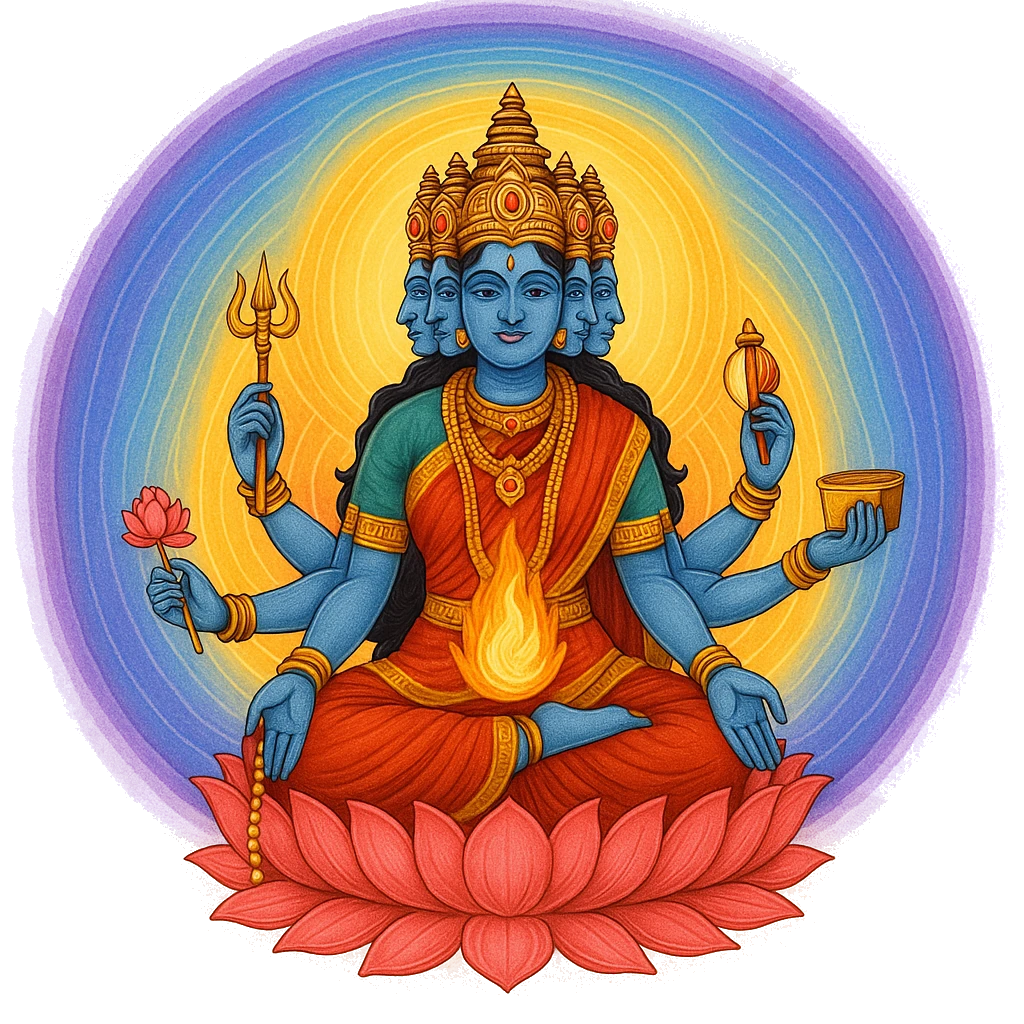
In the ancient traditions of the Vedas and Tantra, sound is not simply a sensory phenomenon
— it is the most primal expression of consciousness.
The universe is said to have begun not with a flash of light, but with a vibration
— a sacred tone that gave birth to form, energy, and mind.
That vibration is called Nāda, and its most refined expressions are mantras.
This chapter explores the alchemy of mantra — how sound becomes transformation,
how vibration becomes silence, and how sacred syllables can alter consciousness itself.
The Mantric Universe: Creation Through Sound
The Śabda Brahman doctrine of the Vedas posits that the ultimate reality is both sound and silence.
In this vision, all that exists has its root in the vibratory field of Nāda.
The first emanation of this vibratory potential is Om — the Pranava, the seed of all mantras.
From Om arises differentiation: elements, deities, thoughts, desires, time.
This primordial sound gives rise to sacred syllables — bīja mantras — which contain the essence of gods, elements, and principles.
Each mantra is not a symbolic invocation; it is a frequency key to a specific domain of consciousness.
To chant a mantra is to activate that reality within and around you. It is alchemy through resonance.
Bīja Mantras – Seeds of Power
Bīja (seed) mantras are single-syllable sounds that encode a full deity's energy.
They are concise, dense with power, and foundational in Tantric sādhanā.
Here are some of the most revered bījas and their associations:
|
Bīja |
Associated Deity |
Function |
|
Aim |
Saraswatī |
Enhances intellect, speech, and memory |
|
Shrīm |
Lakṣmī |
Attracts abundance, beauty, love |
|
Krīm |
Kālī |
Destroys ego, awakens transformative power |
|
Hrīm |
Bhuvaneśwarī / Sundarī |
Expands awareness, awakens inner space |
|
Klim |
Kāma / Desire principle |
Magnetism, devotion, love |
Bīja mantras are used in advanced japa, visualization, and nyāsa (placement rituals)
to stimulate subtle centers and realign energy flow.
Om Namah Śivāya and the Elements
The famous Śiva mantra — Om Namah Śivāya — is composed of five sacred syllables:
Na – Earth (Prithvi)
Ma – Water (Apas)
Śi – Fire (Agni)
Vā – Air (Vāyu)
Ya – Ether (Ākāśa)
These five elements form the building blocks of the universe and the human body.
Chanting this mantra aligns the microcosmic elements with the macrocosmic field.
The final syllable, Ya (Ākāśa), ties directly to Bhuvaneśwarī, the goddess of infinite space.
Mantra, then, is more than devotion — it is inner purification, elemental alignment, and psychic elevation.
Vāk: The Four Levels of Speech
The Rig Veda and later Tantras describe four levels of speech (Vāk), showing how sound descends from subtle to gross:
Parā Vāk – Transcendental speech, unmanifest, felt in the heart. It is pure potential.
Pashyantī – Visual speech; vibration appears as imagery or feeling.
Madhyamā – Mental speech; thoughts and inner dialogue.
Vaikharī – Verbalized speech; external spoken words.
Each level corresponds to a layer of the body and a chakra:
Parā – Heart (Anāhata)
Pashyantī – Ajñā (Third Eye)
Madhyamā – Viśuddhi (Throat)
Vaikharī – Tongue / Mūlādhāra
Mantra begins at the lips but must descend to the heart. Only then does it become transformational.
Mantra Practice as Inner Alchemy
Every time you chant, you are refining vibration into awareness:
Begin with Vaikharī (spoken aloud)
Shift to Madhyamā (mental repetition)
Visualize each syllable as light (Pashyantī)
Rest in silent knowing (Parā)
This process mirrors the Gayatri Mantra’s structure:
The 24 syllables are like petals on a lotus
Each holds a goddess and an energy circuit
Chanting petal-by-petal activates the whole mandala of awareness
Gayatri is not just spoken — she is lived as a frequency field.
Turīya and the Fourth Sound
The Mandukya Upaniṣad introduces Turīya — the "fourth state" of consciousness,
beyond waking (jāgrat), dreaming (svapna), and deep sleep (suṣupti).
Turīya is not a state in time — it is the silent background of all states. It is Shiva.
In mantra:
Spoken words emerge from silence
Silence absorbs the mantra back
Awareness watches both come and go
The fourth sound is not a sound. It is presence.
It is Gayatri beyond language, beyond even Om.
Suggested Practices
Bīja Mantra Nyāsa
Place each mantra syllable on parts of the body
Visualize the deity and element
Gayatri Chakra Chanting
Align each 8-syllable ring with 3 main chakras (navel, heart, brow)
Mantra into Silence Meditation
108 aloud
54 whispered
27 mental
1 in silence
Journal Reflection
“What syllables resonate most with my current path?”
“What is my experience of silence after sound?”
Final Insight
Mantra is not superstition — it is precise technology.
It bridges body and cosmos, sound and stillness, self and Self.
As the mantra refines:
The mind stills.
The heart opens.
The ego dissolves.
And in that dissolution, the voice of the goddess becomes your own.
She does not shout. She whispers through silence.
And that whisper — is mantra perfected.
Mantra Sadhana Techniques
Mantra Sadhana — the disciplined spiritual practice centered around sacred sound
— is at the core of all Vedic and Tantric systems.
The Gayatri mantra, revered as the mother of all mantras,
offers a complete path to inner transformation when approached with reverence, structure, and grace.
This chapter provides foundational and advanced techniques for mantra practice,
covering posture, repetition, breath, visualization, and the energetic dynamics of sound.
Preparing for Mantra Sadhana
Before beginning:
- **Time**: Sunrise, noon, and sunset are ideal (Sandhya times)
- **Space**: Choose a clean, consecrated, quiet space
- **Posture**: Sit upright, stable, relaxed — ideally in Padmasana or Siddhasana
- **Intention**: Begin with a short invocation or prayer to Gayatri or your chosen deity
Repetition (Japa)
The central tool of mantra sadhana is **japa** — rhythmic repetition.
- **Vachika Japa** – aloud chanting
- **Upamsu Japa** – whispering, barely audible
- **Manasa Japa** – mental repetition
Traditionally:
- 108 repetitions = 1 mala (rosary)
- 3 malas = for purification
- 12 malas = for deeper concentration
- 100,000 repetitions = mantra siddhi (attainment)
Breath and Mantra
Synchronize breath with the mantra for deeper integration:
**Option 1 (Natural breathing)**:
- Inhale: mentally recite “Om Bhur Bhuvah Swah”
- Exhale: “Tat Savitur Varenyam…”
**Option 2 (Box breathing with mantra)**:
- Inhale (4 counts) – mantra part 1
- Retain (4 counts) – mantra part 2
- Exhale (4 counts) – mantra part 3
- Hold out (4 counts) – awareness in stillness
This harmonizes the body’s energy and calms the mind.
Nyasa – Installing the Mantra
Nyasa means “placing” — assigning syllables to body parts to sanctify the physical form.
For Gayatri:
- Touch different parts of the body while chanting syllables or bija mantras
- Visualize light entering the body with each touch
Nyasa energizes the body as a **living yantra**.
Visualizing Gayatri
Visualizations to enhance sadhana:
- A **radiant goddess** with five heads and ten arms
- A **solar disc** shining from the heart center
- The **Sri Yantra** rotating within the brow center
- The **24 syllables** glowing around a lotus
Combine japa with these forms to awaken inner perception.
Mantra Bhavana – The Inner Feeling
Bhavana means “inner attitude.” It is the emotional and intentional dimension of practice:
- Feel devotion, surrender, or awe as you chant
- Imagine your body becoming the mantra itself
- Offer the sound as a gift to the divine within
Sound + breath + visualization + feeling = transformation.
Advanced Cycles of Practice
- **Purashcharana**: a set of rules for full mantra attainment (100,000 repetitions per syllable)
- **Sankalpa**: making a vow to complete a set number of japa for a clear goal
- **Fire ritual (homa)**: after completion, offer mantras to Agni for culmination
The power of Gayatri grows with discipline, sincerity, and repetition.
Each recitation reshapes the inner world and aligns the outer.
The mantra becomes the path, the tool, and the destination.
Gayatri in Daily Life – Ritual, Rhythm, and Reverence
Gayatri is more than a mantra — she is a way of life.
For thousands of years, the Gayatri Mantra has served not only as a sacred sound
but as a living spiritual rhythm woven into the tapestry of daily life.
Unlike mantras reserved only for secluded yogis or temple priests, Gayatri invites householders, seekers,
and sages alike into a relationship with time, light, and the divine.
This chapter offers a complete guide to embodying Gayatri through daily practice (sādhanā),
sacred routines, and integration with modern life.
Through intention, rhythm, and presence, every breath becomes a hymn to the divine.
The Three Sandhyas – Anchoring to Light
The three times of day — dawn, noon, and dusk — are known as the Trikāla Sandhyās, or “three junctions.”
These liminal moments are considered the most potent for chanting Gayatri,
as they mark transitions between states of energy, light, and consciousness:
Morning (Prātaḥ Sandhyā) – Symbolizes birth, purity, and intention
Noon (Madhyāhna Sandhyā) – Represents expansion, clarity, and action
Evening (Sāyam Sandhyā) – Brings reflection, integration, and surrender
Chanting Gayatri during these times harmonizes the individual with the solar cycle, inviting internal illumination to align with external light.
Daily Gayatri Sādhanā (Practice Structure)
A simple yet powerful daily Gayatri practice:
Prepare the Space
Sit facing east (morning) or west (evening)
Clean environment; perhaps light a diya (lamp) or incense
Invocation (Dhyāna Śloka)
Mentally invite the presence of Savitṛ, Gayatri Devi, or Tripura Sundarī
Prāṇāyāma (Breath Regulation)
Perform nadi shodhana (alternate nostril breathing)
Inhale – Om Bhur
Retain – Bhuvaḥ
Exhale – Svaḥ
Nyāsa (Placement)
Touch or visualize 24 points on the body, placing each syllable of Gayatri
Envision each syllable as light entering the subtle body
Japa (Chanting)
Aloud (Vaikharī): 108 times
Whispered (Upāmśu): 54 times
Mental (Madhyamā): 27 times
Silent Awareness (Parā): Sit quietly afterward
Offering & Closure
Mentally offer the merit of your practice to all beings
Close with gratitude or a short verse (e.g. Lokāḥ Samastāḥ Sukhino Bhavantu)
Living with Gayatri – Integration into Life
You don’t need a temple to honor Gayatri — your daily actions can become offerings:
At dawn, recite a single Gayatri while facing the sun
While cooking, chant silently to infuse food with clarity
During difficult moments, breathe in her light, exhale resistance
Before sleep, mentally offer your thoughts and memories into her flame
Spirituality does not require escape — only attention.
The Gayatri path teaches that every moment contains the divine if we know how to see.
Gayatri as a Goddess in the Heart
In more devotional forms of practice, Gayatri is visualized as a five-faced goddess, seated on a red lotus, radiating five streams of light.
Each face corresponds to a layer of reality —
East – Knowledge (Vedas)
West – Prosperity (Lakshmi)
North – Clarity (Saraswati)
South – Power (Durga)
Center – Bliss (Tripura Sundarī)
The heart is her throne.
Each beat becomes her mantra.
Chanting is not a performance but a remembering
— aligning our fragmented mind with the wholeness she represents.
Practices for Modern Seekers
Gayatri Mindfulness Walk
Walk in silence while repeating the mantra mentally
Let the rhythm of your steps match the 24 syllables
Solar Meditation
Sit outside at sunrise
Visualize golden light entering the crown with each syllable
Digital Detox with Mantra
Begin screen use only after 15 minutes of morning japa
Replace social scrolling with silent chanting during breaks
Family Invocation
Chant once aloud before meals or shared activities
These simple acts restore presence and elevate ordinary life into spiritual offering.
The Alchemy of Rhythm
Gayatri Mantra’s 8-8-8 meter (triṣṭubh chandas) aligns consciousness with divine rhythm.
Just as the breath follows inhale-hold-exhale,
Gayatri follows intention-illumination-action.
First line (Tat savitur…) – Focus / Invocation
Second line (Bhargo devasya…) – Illumination / Deity
Third line (Dhīyo yo naḥ…) – Integration / Blessing
This daily rhythm is not only Vedic, it is cosmic — echoing the rhythm of days, seasons, and lifetimes.
To live with Gayatri is to live with light — not external sunlight alone, but the light of awareness.
She becomes the pulse of life — a heartbeat made of mantra.
Chapter 7 -Sacred Forms: Yantra, Śrī Chakra, and the Geometry of the Goddess
Part_4:_Sacred Space >Part 4: Sacred Forms & Myths
Yantra, Śrī Chakra, and the Geometry of the Goddess
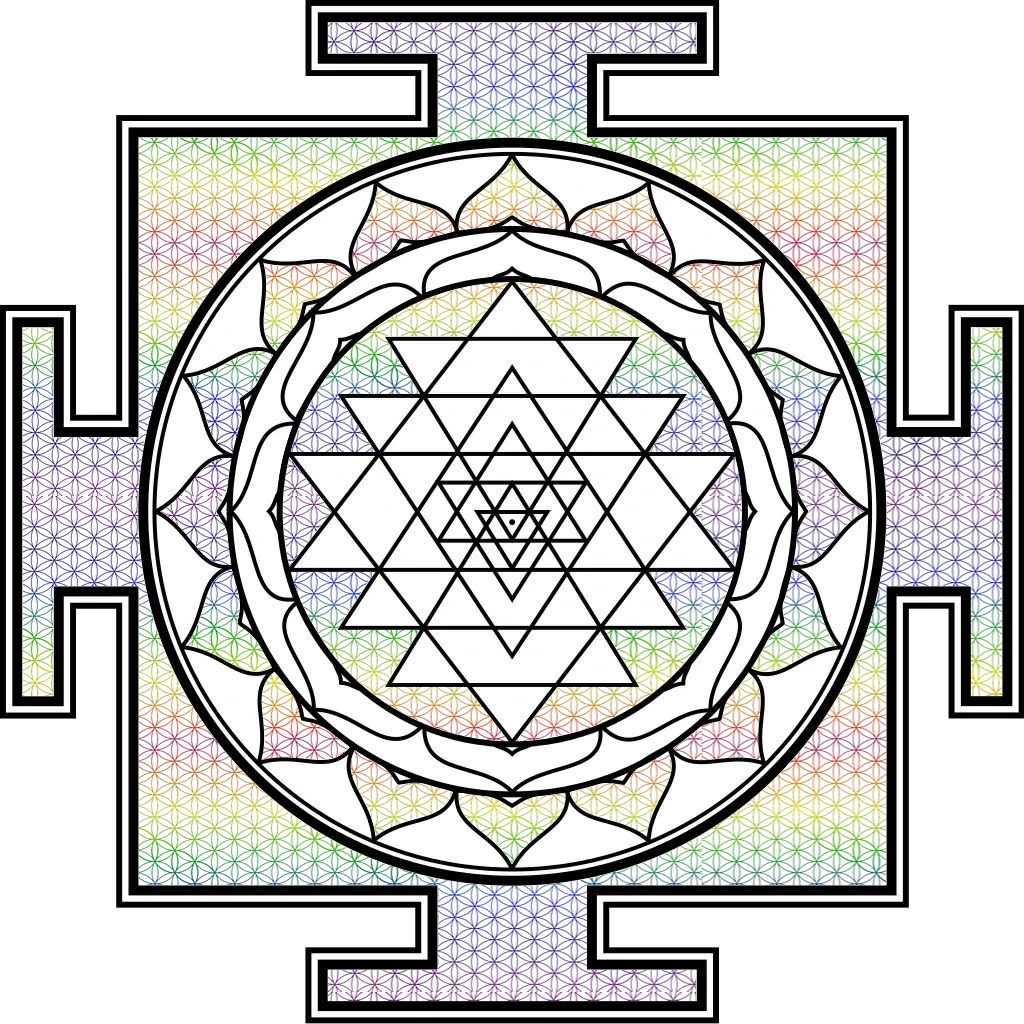
In the great stream of Tantric wisdom, sound and sight are considered twin forces of creation.
Where mantra is sound-form, yantra is form-sound.
Yantra, meaning "instrument" or "device," is a visual mandala through which the cosmos is both depicted and accessed.
For the devotee of Gayatri and Tripura Sundarī, the yantra becomes a map of consciousness
— a sacred mirror in which the Goddess reflects Herself.
This chapter explores the nature, purpose, and mysteries of yantra practice, with a focus on the supreme diagram:
the Śrī Chakra — the throne of Tripura Sundarī and the energetic temple of Gayatri.
What is a Yantra?
A yantra is not merely an artistic drawing. It is a geometry of subtle forces.
Where the mind perceives forms as separate and random,
the yantra reveals how all arises from a central point of stillness (bindu) and radiates outward in ordered energy.
Key elements include:
Bindu: The central point — source and destination
Triangles: Representing Shakti (downward) and Shiva (upward)
Circles: Movement, continuity, flow
Lotuses (Padmas): Petals of the subtle body and layers of divinity
Bhūpura: Outer square — the boundary of ego, body, and the world
Meditating on a yantra is not symbolic — it is energetic entrainment.
As the eyes trace the form, the inner mind begins to align with the frequencies of order, clarity, and stillness.
The Śrī Chakra – The Supreme Yantra of the Goddess
The Śrī Chakra (also called Śrī Yantra) is the most revered and powerful of all yantras.
It is the energetic body of Tripura Sundarī, the central face of Gayatri
and embodiment of pure, radiant consciousness within form.
It is composed of:
9 interlocking triangles
4 upward (Shiva, awareness)
5 downward (Shakti, energy)
Together they form 43 smaller triangles, each housing a goddess
3 concentric circles and 2 lotus rings
A surrounding square (bhūpura) with 4 gates — aligned to the cardinal directions
The Śrī Chakra is a temple in diagrammatic form, designed to be entered in meditation.
It represents:
The human body (microcosm)
The cosmos (macrocosm)
The journey from outer experience to inner awakening
The Nine Levels of the Śrī Chakra (Navāvaraṇa)
Each layer of the yantra is called an āvaraṇa (veil or enclosure).
Together, they represent the stages of consciousness:
Trailokya Mohana Chakra – The outer square; attraction of the world
Sarva Aśa Paripuraka Chakra – Fulfillment of all desires
Sarva Saṁkṣobhaṇa Chakra – Stirring of spiritual yearning
Sarva Saubhāgya Dāyaka Chakra – Blessings and grace
Sarvārtha Sādhaka Chakra – Fulfillment of life purposes
Sarva Rakṣākara Chakra – Protection from inner and outer harm
Sarva Rogahara Chakra – Healing of all afflictions
Sarva Siddhiprada Chakra – All attainments and yogic powers
Sarvānanda Mayī Chakra – The central bindu, pure bliss
Each level is inhabited by specific goddesses,
called Yoginīs, Śaktīs, and guardians of that enclosure.
The practitioner moves from the outer square inward through mantra, visualization, and devotion
— until Tripura Sundarī is revealed in the center.
Gayatri and the Śrī Chakra
While not often discussed, the Gayatri Mantra maps beautifully onto the structure of the Śrī Chakra:
The 24 syllables can be seen as 24 lotus petals, forming 3 concentric rings
The triśṭubh meter (8-8-8) aligns with the threefold world and the three cities (Tripura)
Gayatri's invocation of light, intellect, and awakening parallels the inner ascent of consciousness through the yantra
Each syllable, when placed on a petal or triangle, becomes a vibrational deity.
This transforms the yantra from a picture to a living field of Shakti.
Practice: How to Meditate with the Śrī Yantra
Trāṭaka (Gazing Practice)
Place the yantra at eye level
Sit at a comfortable distance
Gaze softly at the central bindu
Let thoughts dissolve into form
Mantra Infusion
Chant "Om Bhur Bhuvaḥ Svaḥ…" while visually moving inward
Place each syllable on a petal, triangle, or circle
Rest in silence at the bindu
Internal Yantra Visualization
Visualize the entire yantra in the heart
Light it with golden or ruby light
See the goddess seated in the center — her five faces radiant
Walking the Navāvaraṇa (Layer by Layer)
Spend time with each enclosure
Study the names, colors, and śaktis
Reflect on how that layer operates in your life
Insight: The Inner Geometry of Self
The Śrī Chakra is not just a visual object — it is a blueprint of the soul. The outer square is the conditioned self.
The inner bindu is the pure witness.
The path inward is the path of all spiritual realization — movement from form to essence, from doing to being.
By meditating on the yantra, one does not visualize the divine — one reveals it.
As Gayatri is the mantra of enlightened intellect, the Śrī Chakra is the yantra of embodied wisdom.
One is sound, the other form. Both are light.
To hold them together — to chant and gaze, to visualize and recite — is to become the goddess, remembering herself through you.
Yantra Creation and Sacred Diagram Rituals
Yantras are the visual counterparts of mantras
— geometric diagrams that condense vast spiritual energies into symbolic, sacred form.
In Tantric traditions, yantras are used not only for meditation but for consecrating space,
invoking deities, and embodying divine principles in material reality.
In the context of Gayatri, the Sri Yantra is the supreme representation.
But yantras can also be custom-drawn for each Mahavidya, for Bhuvaneshwari, for the planets, and for mantra-specific energies.
Creating and worshiping a yantra is an art, science, and spiritual practice.
What is a Yantra?
The Sanskrit word “Yantra” comes from the root *yam*, meaning to control or support. A yantra is:
- A **spiritual circuit** composed of lines, triangles, circles, and lotuses
- A **psychocosmic map** that mirrors the inner subtle body
- A **residence of the deity**, activated through mantra and devotion
Yantras operate through **resonance**: when meditated upon, they align your vibration with the cosmic forces they represent.
The Sri Yantra and Gayatri
The Sri Yantra consists of:
- **9 interlocking triangles**: 4 upward (Shiva), 5 downward (Shakti)
- **43 smaller triangles**: Represent the cosmos in fractal form
- **Central bindu**: The point of origin — Gayatri as pure awareness
- **Lotus rings and bhupura**: Manifested reality, consecrated space
It is the visual embodiment of **Tripura Sundari**, the heart of the Gayatri mantra.
Creating a Yantra
**Materials**:
- Clean, white or copper sheet (for drawing or engraving)
- Red, yellow, and black natural pigments
- Ruler, compass, and fine-point pen/brush
- Mantra written in Devanagari or inscribed mentally
**Steps**:
Bathe and set up a clean, quiet space
Chant Gayatri or deity mantra before beginning
Draw from center (bindu) outward — symbolizing creation from stillness
Each line is drawn with awareness and intention
Install the mantra within the yantra (mental or written)
Yantras must be made **in a sattvic state**, and preferably during auspicious astrological timings.
Ritual Use of Yantras
- Place the yantra on your altar facing east
- Light a lamp and offer incense, flowers, or water
- Chant the corresponding mantra (e.g. Gayatri, Mahavidya, or planetary mantra)
- Meditate by gazing at the bindu (central point) with relaxed focus
- Use during Navaratri or planetary transits for transformation
Yantras are also installed in temples, homes, and even within the **subtle body**
through advanced visualization practices.
Inner Yantra Meditation
- Visualize the yantra within your heart center
- Chant mantra and allow the geometry to radiate light outward
- Feel each circuit (āvaraṇa) open a layer of consciousness
- Dissolve attention into the bindu — the center of all forms
When combined with Gayatri, the yantra becomes **an inner temple**
— guiding the soul through creation, preservation, dissolution, and realization.
It is a map to the **cosmic self**
— traced not in ink, but in light and awareness.
Chapter 8 -The Inner Temple – Non-Duality, Chakras and the Gayatri Current
The Inner Temple – Union, Non-Duality, and Living as Light
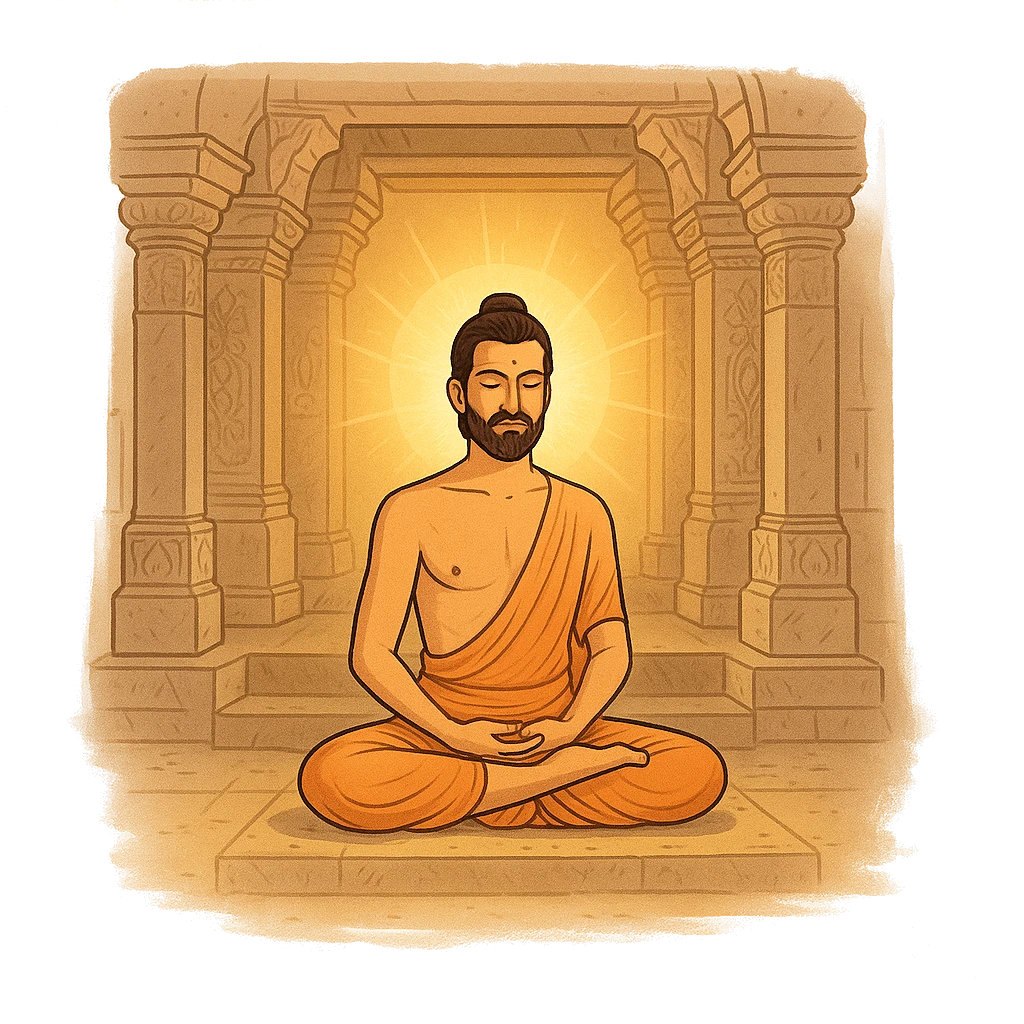
The culmination of all mantra, meditation, and goddess-centered practice is not merely knowledge or power
— it is the direct experience of union.
In this union, all divisions dissolve: Shiva and Shakti,
subject and object,
inner and outer,
self and cosmos.
This is the realization of non-duality — Advaita — where the seeker,
the seeking, and the sought are revealed to be one.
This realisation is symbolised in the sacred concept of the Inner Temple.
While outer rituals may be performed in temples of stone and gold,
the true temple is the awakened heart, the still mind, the luminous core of being.
It is here that the Gayatri Mantra fully blooms — not just as sound, but as self-revelation.
Each face of Gayatri, each petal of her 24-syllable lotus, leads the practitioner inward.
Each deity form — Lakshmi, Saraswati, Durga, Savitri, Tripura Sundari
— becomes not an external being to be worshipped,
but a mirror of the multifaceted inner Self.
And beyond all form, there is space — Bhuvaneshwari
— where all gods and mantras dissolve into silence.
To live in non-duality is not to retreat from the world,
but to engage with it without illusion.
You see the divine in every face, every sound, every shadow.
Even in suffering, you glimpse the play of Shakti.
Even in silence, you feel the pulse of Shiva.
This is the “living light” — the effortless radiance of one who no longer resists the truth.
In this state, practices become spontaneous.
One may still chant mantras, but not as effort — rather, as joy.
One may still meditate, but not to escape — rather, to deepen presence.
One may serve others, but without ego — because the self has become the all.
This is the flowering of spiritual maturity.
The boundaries of sacred and mundane collapse.
Life itself becomes a ritual, breath becomes mantra, and the body becomes a moving shrine.
Even time — Kala — no longer dominates.
You live in the eternal now.
Tripura Sundari is this state made manifest — beauty that shines from within.
Kali protects this realization by removing falsehood.
Bhuvaneshwari holds it in spacious awareness.
And Gayatri lights the way.
To dwell in the Inner Temple is to know the Self as Brahman — infinite, conscious, blissful.
You are not in the universe; the universe is in you.
In this final union, you become not the one who chants the mantra, but the mantra itself.
Not the light that seeks the source, but the light that shines without source — eternal, luminous, free.
Om divides itself into the threefold light, manifesting the three worlds:
Bhūr (भूर्): The physical, gross plane – Earth, body, materiality.
Bhuvaḥ (भुवः): The subtle, energetic plane – Prāṇa, thought, the breath-realm.
Svaḥ (स्वः): The causal, celestial plane – Archetypes, time, karma, and higher intelligence.
These are not just worlds “out there” — they are layers of perception within each of us.
Together, they form the Tripura (त्रिपुरा)—the "three cities" of consciousness,
ruled by Tripura Sundari, the goddess who exists across and beyond them.
Tripura Sundari and the Reflection of Awareness
Tripura Sundari (त्रिपुरा सुन्दरी) is consciousness reflecting upon itself in beauty.
She is the dynamic spark of creativity, arising in response to the witnessing awareness of Shiva and the containing matrix of Bhuvaneshwari.
She dances between form and formlessness, the bridge between the manifest and the unmanifest.
Whereas Bhuvaneshwari is passive space, Tripura is conscious presence within that space
—aware of being aware, and thus the first deity of refined self-recognition.
She is the mirror that Shiva (Awareness) holds to see Shakti (Energy), and vice versa.
Kala (Time), Shiva, and Kali
Time—Kāla (काल)—does not begin with a ticking clock, but with movement in awareness.
The first ripple in stillness creates sequence, rhythm, and causality.
When awareness looks upon itself, Kāla is born.
In the tantric view:
Shiva is the silent substrate of time, the unchanging axis.
Kali is time itself, devouring and birthing every moment.
Together, they unfold the universe in cyclical patterns: yugas, breaths, lifetimes.
The Gayatri Mantra, with its 24 syllables, represents this unfolding of time,
each syllable like a seed in the womb of consciousness that explodes into light, matter, and experience.
Hiranyagarbha: The Golden Egg
The earliest form that arises from this vibratory matrix is the Hiraṇyagarbha (हिरण्यगर्भ)—the Golden Womb or Cosmic Egg.
It is the luminous seed of the cosmos, shimmering in infinite space.
It holds the essence of Savitā—the solar radiance, the divine spark of creative intelligence.
"In the beginning was Hiraṇyagarbha, the One Lord of all that is born.
He upheld the heavens and the earth.
To Him, we offer our praise." — Ṛg Veda 10.121
Savita and the Light of Awareness
Savita (सविता) is not just the physical sun but the intelligence of illumination itself.
He is the radiant awareness that animates all things.
His light is not merely seen—it is what enables sight.
He is invoked in the Gayatri Mantra:
तत् सवितुर् वरेण्यं भर्गो देवस्य धीमहि
“We meditate upon that adorable light of the divine Savita...”
He is not separate from Gayatri—he is her solar heart, her masculine reflection,
while she is the luminous field that contains and transmits that awareness.
Ṛta and the Embodiment of Cosmic Order
Ṛta (ऋत) is the cosmic order, the underlying harmony of the universe.
It is not imposed—it emerges from the perfect balance between consciousness and form, Shiva and Shakti.
Gayatri is said to embody Ṛta. Each syllable of the mantra is not random—it is aligned with cosmic rhythms.
Chanting the Gayatri is not just prayer—it is attunement to the structure of the universe itself.
Gayatri as Mirror of Creation
To chant Gayatri is to replicate the act of creation: from silence to vibration to syllable to consciousness to form.
Each time we invoke the mantra, we reenact the birth of time, the dance of light,
and the emergence of awareness from the womb of potential.
Gayatri is not a goddess about light—she is the light becoming aware of itself.
Summary Insights
Bhuvaneshwari is the container of space, the primordial womb.
Nāda and Om are the first vibrations that disturb stillness.
The Tripura model explains the universe in three levels of experience.
Tripura Sundari is consciousness in bloom—aware, radiant, alive.
Shiva and Kali govern the birth of Time, and Gayatri flows along its current.
Hiraṇyagarbha is the cosmic egg—the first enclosure of light.
Gayatri, through 24 syllables,
gives rhythmic order to vibration and reconnects us to Ṛta, the cosmic law.
The Role of the Guru and Transmission
In the ancient traditions of Sanātana Dharma, the Guru is not merely a human being.
The Guru is a tattva—a metaphysical principle, a living embodiment of awakened Jnana (wisdom).
In the Gāyatrī tradition, the Guru holds a role that is not just symbolic but energetically essential:
they are the transmitter of divine fire, the one who bridges the unawakened and awakened states of being.
The word Guru is often translated as “dispeller of darkness” (Gu = darkness, Ru = remover),
but in esoteric understanding, the Guru is also gravity: the one who draws you back into the core of your Self.
Guru as Principle, Not Personality
The Guru is not a personality to be clung to, idolized, or feared.
The Guru is a mirror, a spark of clarity who reflects your own potential back to you.
In Gāyatrī-oriented paths, the Guru can appear in four forms:
The Outer Guru – a living being who gives mantra and guidance
The Inner Guru – the subtle presence that arises in deep practice
The Scriptural Guru – texts and revelations that illuminate
The Cosmic Guru – Tripura Sundari or Brahman itself, reflected through all
Thus, the Guru is simultaneously a person, a presence, a vibration, and the Self.
Shaktipāta: The Inner Fire Ignited
The transmission of the Gāyatrī Mantra is not merely verbal—it is energetic, intentional, and subtle.
This is known as Shaktipāta (शक्तिपात) — the descent of energy from the awakened state into the seeker.
Without this charging of the mantra, its syllables remain inert.
It is said in Tantra:
“Mantra without consciousness is but wind.”
The Guru charges the mantra through their own mantra chaitanya (mantra-consciousness),
accumulated through years—sometimes lifetimes—of japa and tapasya.
The Four Aspects of Transmission
1.Sankalpa (संकल्प) – Intention Planting
The Guru silently establishes an intention (sankalpa) for the seeker’s awakening.
This is the seed.
The field is the subtle body of the student.
Without Sankalpa, even a powerful mantra may not take root.
2.Nyāsa (न्यास) – Energetic Placement
The syllables of Gāyatrī are placed into different parts of the body,
usually mentally or with the Guru’s hand.
For example:
“Tat” is placed in the heart
“Savitur” in the crown
“Vareṇyam” at the third eye
This sacred body-mapping turns the student’s form into a living yantra.
3.Dīkṣā (दीक्षा) – Mantra Initiation
In many traditions, the Guru whispers the mantra into the right ear in a sanctified space, often during dawn.
This moment is the birth of the mantra in the student’s inner world.
As the Vedas say:
"Only by initiation is the mantra made alive."
4.Mantra Chaitanya (मन्त्र चैतन्य) – Conscious Mantra
The mantra is not just sound. It is a living force, but only when awareness is infused into it.
The Guru transmits not just the words but their vibration, memory, and power.
This is prāṇapratiṣṭhā—the energizing of mantra as deity.
Lineage and Tradition
The transmission of Gāyatrī Mantra is never random.
It is carried through Sampradāyas (spiritual lineages), which act as rivers of transmission.
Prominent ones include:
The Saraswati-Kanchi lineage: Emphasizing purity, study, and brahmavidyā
The Nath Yogic lineages: Merging mantra with pranayama and inner alchemy
The Southern Tantric Sampradāyas: Where Gāyatrī is seen as an aspect of Tripura Sundarī,
and mantra becomes a gateway to śakti awakening
In these traditions, the outer Guru is merely a vehicle—a mouthpiece of the Inner Guru,
who is Tripura Sundarī herself.
Advanced Practices
For the dedicated practitioner, the Guru’s transmission continues long after initiation:
Ajapa Gayatri: The mantra breathes itself within you—no effort is needed.
This is the ultimate goal: to become the mantra.
Visualising the Guru as light at the crown chakra, descending through the spine
Breathing the mantra down the sushumna nadi (central channel), aligning with chakras
Guru-Dhyāna: Meditating on the Guru as non-different from consciousness itself
The Guru Within
Over time, the distinction between “Guru” and “Me” dissolves.
The outer Guru leads the student inward to discover the Guru within.
As the Kena Upanishad declares:
"That which cannot be seen by the eye, but by which the eye sees—that alone is the Self, and that is to be known as the Guru."
In the Gāyatrī tradition, this means the chanter, the mantra, and the light being invoked ultimately converge into oneness.
Mantra Siddhi and the End of Seeking
When practice matures, a point comes when the mantra recites itself within the heart.
This is known as Ajapa Japa—unspoken repetition.
Eventually, mantra becomes identical with being.
This is called Mantra Siddhi—not magical powers, but total fusion:
The sound becomes silent
The deity becomes the self
The seeker becomes the sought
This is not theory—it is a lived reality in the great Gāyatrī lineages.
Summary Reflection
The Guru is the fire that awakens the mantra.
Without Shaktipāta, mantra is dormant.
Through sankalpa, nyāsa, dīkṣā, and chaitanya, the mantra is born and made alive.
The ultimate Guru is Tripura Sundarī, radiating through sound, space, and soul.
To chant Gāyatrī with awareness is to sit at the feet of the Infinite Guru.
Every syllable becomes a step toward the final illumination.
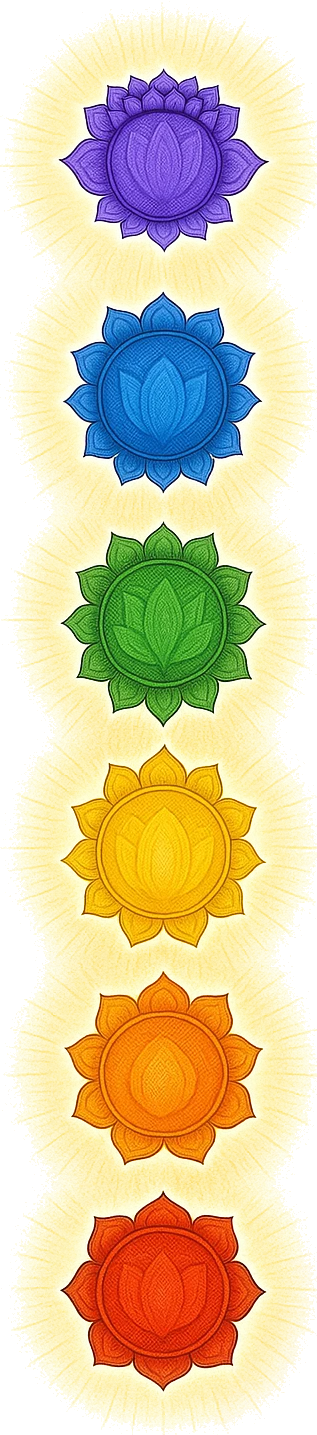
Chakras and the Gayatri Current – A Journey Through Inner Light
Within the subtle yogic anatomy of the human being, the chakras — energy centers aligned along the spine
— serve as junctions of body, mind, and spirit.
Each chakra governs a domain of experience, a frequency of energy, and a layer of our evolutionary potential.
When approached through the lens of Gayatri, these chakras become the stages of illumination,
each activated by syllables, bija mantras, and corresponding deities.
Gayatri does not only move through the air as sound — she moves through the spine as light.
This chapter explores how the 24 syllables of the Gayatri Mantra align with the chakra system,
how bīja mantras awaken their latent forces, and how mantra becomes a ladder of ascent.
The Seven Chakras: Energy Portals of the Inner Temple
Mūlādhāra (Root Chakra)
Element: Earth
Bīja: Lam
Governs: Survival, security, grounding
Gayatri Connection: Base mantra foundation — the syllables Tat Sa Vi awaken stability and courage
Svādhiṣṭhāna (Sacral Chakra)
Element: Water
Bīja: Vam
Governs: Emotion, pleasure, sexuality
Gayatri Syllables: Tu Rē Ṇyam — stimulating the sacred currents of desire and creative flow
Maṇipūra (Navel Chakra)
Element: Fire
Bīja: Ram
Governs: Willpower, digestion, confidence
Gayatri Syllables: Bhar Go Dē — igniting inner fire and transformation
Anāhata (Heart Chakra)
Element: Air
Bīja: Yam
Governs: Love, compassion, harmony
Gayatri Syllables: Va Sya Dhī — opening the gateway to universal love
Viśuddhi (Throat Chakra)
Element: Ether (Ākāśa)
Bīja: Ham
Governs: Communication, truth, purity
Gayatri Syllables: Ma Hi Dhi — purifying speech and invoking divine articulation
Ājñā (Third Eye Chakra)
Element: Light
Bīja: Om or Ksham
Governs: Intuition, clarity, higher sight
Gayatri Syllables: Yo Yo Na — activating the seer within
Sahasrāra (Crown Chakra)
Element: Pure Consciousness
Bīja: Silence or Om
Governs: Unity, transcendence, illumination
Gayatri Syllables: Pra Cho Da Ya Om — culminating in absorption into source
Visualizing Gayatri in the Chakras
Imagine each chakra as a lotus of light.
As the Gayatri syllables are chanted, they rise like a current:
Begin with red light at the root, vibrating Tat
Ascend orange at the sacral with Sa Vi Tu
Blaze yellow at the navel with Re Ṇyam Bhar
Bloom green at the heart with Go Dē Va
Radiate blue at the throat with Sya Dhī Ma
Illuminate indigo at the third eye with Hi Dhi Yo
Dissolve violet at the crown with Yo Naḥ Pra Cho Da Ya Om
Each syllable is both a mantra and a mudrā of light within the body.
Tripura Sundarī as the Axis
The goddess Gayatri, in her Tripura Sundarī form,
sits at the intersection of the three worlds and three bodies
— gross (sthūla), subtle (sūkṣma), and causal (kāraṇa). The chakras represent this trinity as well:
Lower 3 chakras = Gross (body, instincts)
Middle 2 = Subtle (mind, emotion)
Upper 2 = Causal (intuition, unity)
Tripura Sundarī unites these worlds — her mantra becoming the bridge from root to crown.
Suggested Practices
Chakra Japa Ladder
Chant 3 syllables per chakra, ascending upward
Visualize color, element, deity
Nyāsa with Gayatri
Place each of the 24 syllables on chakra points, palms, and crown
Chakra Tuning with Bīja + Gayatri
Combine Lam + Tat
Vam + Sa
... until Om + Om
Laya Yoga Meditation
Let the sound dissolve into light
Let the light dissolve into awareness
Realizing the Subtle Body
The chakras are not anatomical — they are fields of possibility,
awakened through attention, vibration, and intention.
Gayatri is the thread that weaves these centers together,
reminding us that we are not simply physical beings — we are temples of resonance.
To chant her is to light each lamp along the spinal shrine.
To breathe her is to animate the sacred wind (prāṇa) through the subtle pathways (nāḍīs).
And to merge with her is to become luminescent awareness — the rainbow bridge between earth and source.
Gayatri is not merely chanted — she is embodied, chakra by chakra, light by light.
Chapter 9 -Planetary Energies (Navagraha)
Part 5: Celestial Energies & Speech
Planetary Planetary Energies (Navagraha) and Gayatri’s Solar Alignment
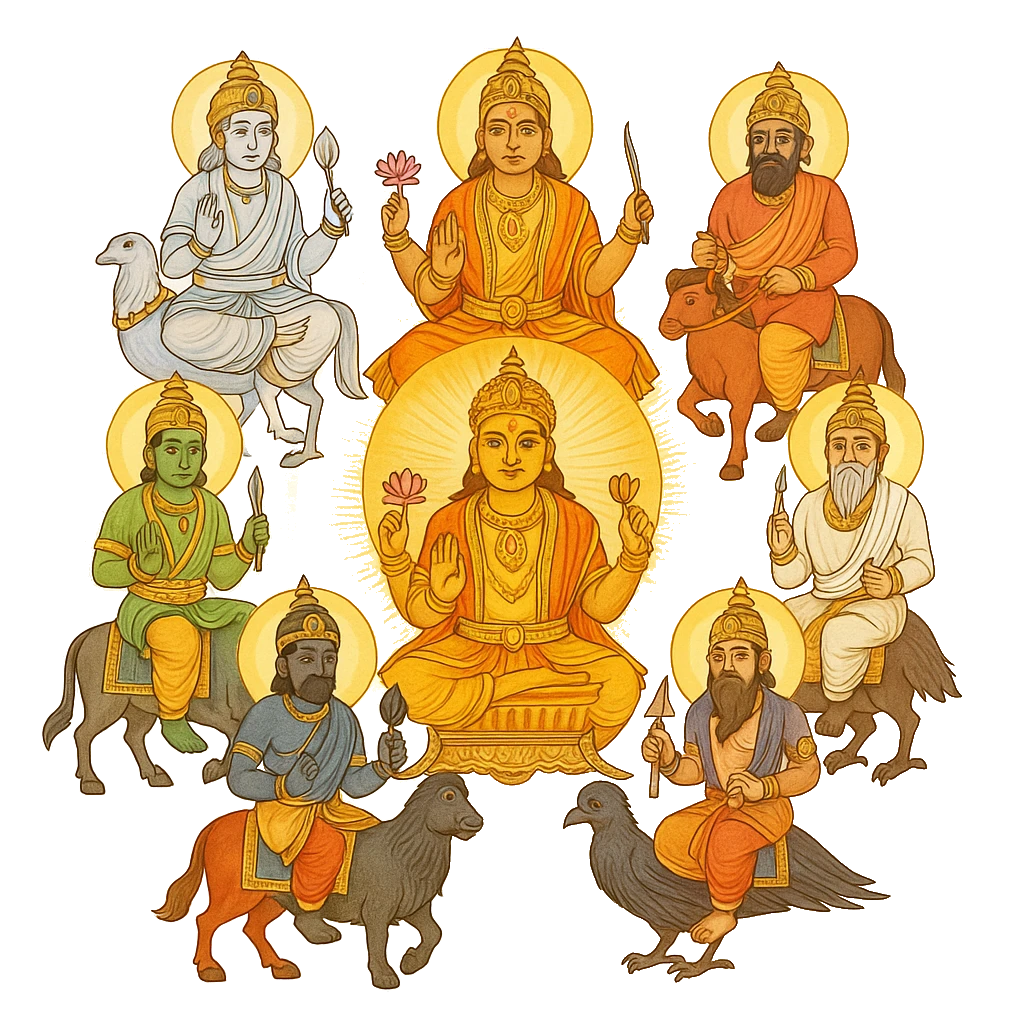
In Vedic cosmology, the Navagraha — nine planetary forces
— are not merely astronomical entities but conscious energies that influence human life, karma, and spiritual evolution.
Among them, the Sun (Surya) is the central pillar, and the Gayatri mantra, addressed to **Savitur** (the solar deity),
is considered the supreme remedy and alignment mantra.
This chapter explores the relationships between the Gayatri mantra and the Navagraha,
revealing how its daily practice brings harmony with cosmic rhythms.
Surya – The Solar Heart of Gayatri
Surya (Savitur) is the divine Sun — not just physical light, but **spiritual illumination**.
He governs:
- Vitality, prana (life force)
- Vision and higher awareness
- Authority, clarity, and the soul (Atman)
The Gayatri mantra is a hymn to **Tat Savitur Varenyam**
— “That adorable radiance of Savitur,” asking it to awaken our intelligence (dhī).
Daily chanting at sunrise brings:
- Alignment with **diurnal energy flow**
- Strengthening of the **solar plexus (manipura chakra)**
- Balancing of karmic patterns influenced by Surya
The Nine Planetary Forces (Navagraha)
1. **Surya (Sun)** – soul, willpower, insight
2. **Chandra (Moon)** – mind, emotions, intuition
3. **Mangala (Mars)** – energy, drive, discipline
4. **Budha (Mercury)** – intellect, speech, logic
5. **Guru (Jupiter)** – wisdom, expansion, devotion
6. **Shukra (Venus)** – love, beauty, pleasure
7. **Shani (Saturn)** – karma, discipline, time
8. **Rahu (North Node)** – ambition, illusion, sudden change
9. **Ketu (South Node)** – detachment, past karma, spirituality
Gayatri and the Planets
Gayatri acts as a **harmonic field** that balances planetary energies:
- **Surya** is its presiding deity
- **Chandra** is balanced by its mental focus
- **Budha** is strengthened through articulation and intellect
- **Shani** is harmonized by discipline and repetition
- **Rahu/Ketu** are neutralized through higher awareness
Thus, Gayatri is called the **universal mantra of planetary pacification**.
Many planetary afflictions (graha dosha) in astrology are reduced through Gayatri japa.
Astrological Practice with Gayatri
- Chant Gayatri **12 or 36 times during solar hours** (6–7:30 AM)
- Face the east, feel solar warmth on your brow and heart
- Offer water (Arghya) to the rising Sun before japa
- For specific graha balancing, use **Gayatri variants** (e.g., Chandra Gayatri, Shani Gayatri)
Aligning mantra with the planetary calendar makes the practice more potent.
Navagraha yantras and mantras may also be placed around the main Sri Yantra for enhanced results.
Solar Consciousness and the Inner Planets
Each planet corresponds to a psychological principle:
- Sun: awareness
- Moon: receptivity
- Mars: assertion
- Mercury: thought
- Jupiter: growth
- Venus: connection
- Saturn: maturation
- Rahu/Ketu: awakening through challenge
The Gayatri mantra synchronizes these **inner planets**,
helping the yogi live in harmony with time (kala),
space (bhuvaneshwari),
and energy (shakti).
To chant Gayatri is to call forth **solar intelligence** within
— a sun that shines in every cell, thought, and breath.
Gayatri in Daily Life and Modern Practice
The Gayatri mantra is not reserved for monasteries or ritual halls
— it is a living frequency of consciousness that can sanctify everyday life.
In the fast-paced rhythms of the modern world, Gayatri offers a bridge between timeless wisdom and contemporary living.
This chapter explores how to apply Gayatri across different spheres
— from family and work to healing, creativity, and mindfulness.
Integrating Gayatri into Daily Routine
The mantra is traditionally recited three times a day during **Sandhyavandana**
— sunrise, noon, and sunset.
But it can also be integrated into daily life with flexibility:
- **Morning**: Chant or listen to Gayatri upon waking — facing east
- **Commute**: Mentally chant during travel for calm and protection
- **Work breaks**: Recite quietly during short pauses to reset attention
- **Evening**: Use japa to unwind, clear mental clutter, and invoke clarity
Even a few repetitions bring resonance, especially when paired with breath and heart intention.
Mindful Moments with Gayatri
- Before meals, chant to infuse food with prana and gratitude
- While walking, coordinate steps with syllables (gait-matching)
- During transitions (from work to home), use as an energetic cleanser
- For emotional regulation, use the mantra to ride waves of reaction
Gayatri becomes a **portable sanctuary**
— a subtle flame of awareness in the noise of life.
Healing and Wellness Applications
Gayatri is known for its protective and healing properties. When chanted with faith and discipline, it can:
- Calm anxiety and reduce mental fatigue
- Balance breath and heart rhythms
- Support recovery by aligning the body with healing prana
- Be directed toward others (distance healing)
For physical healing, **japa with sankalpa (intention)** amplifies results.
Visualize the syllables as golden light entering the affected area.
Gayatri and Children
Traditionally, Gayatri is taught at **Upanayana** (initiation),
but it can be shared gently with children:
- As a lullaby (soft melodic recitation)
- As a morning ritual to foster calm and focus
- As a chant during difficult emotional moments
The mantra awakens innate intelligence and resilience.
Creative Expression and Gayatri
- Chant before artistic work for inspiration
- Use Gayatri-infused water or incense during creative sessions
- Meditate on the 24 syllables as seeds of **sound, image, and emotion**
Many artists, writers, and musicians use mantra to unlock intuitive flow and insight.
Gayatri as a Lifelong Companion
Over time, Gayatri shifts from a technique to a **presence**:
- The mantra chants itself in silence
- It becomes the **background hum of awareness**
- It aligns you with **truth, love, and dharma** — moment to moment
Whether in a temple or traffic, sadness or celebration,
Gayatri becomes the golden thread that binds daily life to divine realization.
The Feminine Voice of the Veda and Gayatri as Divine Sound
Gayatri Devi is more than a mantra or goddess — she is the embodiment of the **feminine voice of the Veda**,
the vibratory essence of consciousness clothed in sacred sound.
In her form, the eternal wisdom of the cosmos sings through syllables, rhythms, and resonance.
This chapter reflects on Gayatri as not just the “Mother of the Vedas,”
but the **song of the universe itself** — carrying the divine into human awareness.
Vak: The Sacred Speech
In Vedic cosmology, **Vak (Speech)** is both a deity and a cosmic principle.
She is:
- The **origin of the Vedas**
- The mother of all mantras
- The dynamic expression of **Brahman** (universal consciousness)
Gayatri is Vak in mantra form — the **vehicle of revelation**
through which seers (rishis) receive truth.
In the Rig Veda, Vak declares:
> “I pervade heaven and earth… I create the father of the world… I am the Queen, the gatherer of treasures…”
Thus, Gayatri is not prayed *to*
— she is the **prayer itself**, speaking through us.
Gayatri as Cosmic Song
The 24 syllables of Gayatri align with:
- The **24 meters (chhandas)** of Vedic verse
- The **24 tattvas** or principles of creation
- The **24 aspects of Devi** in her mantra-form embodiment
Her mantra is the **harmonic blueprint** of spiritual and material reality:
- It begins in **Bhu (earth)** — the body
- Moves through **Bhuvah (mind)** — the breath
- Ascends to **Svah (spirit)** — the soul
Then it calls forth **Tat (That)** — the impersonal divine,
and invokes its radiance (Savitur) to awaken **Dhi (intelligence)** within us.
Gayatri is the **sound-bridge from form to formlessness**.
The Feminine Veda: Sruti and Resonance
"Sruti" means “that which is heard.” The Vedas were not composed
— they were **received** through deep meditative states.
The rishis were not authors but **listeners** to the divine resonance.
Gayatri’s mantra arises from this same source: **para vak**,
the unspoken speech of pure wisdom.
In this way:
- The Veda is **Shakti as knowledge**
- Gayatri is **Shakti as vibration**
- Vak is **Shakti as voice**
To chant Gayatri is to allow the feminine Veda to **sing through your being**.
The Mantra as the Goddess
In the final realization, Gayatri is not separate from the Self. She is:
- The **breath that chants**
- The **mind that contemplates**
- The **heart that radiates**
- The **awareness that listens**
Every time the mantra is recited with devotion and presence, the Goddess **awakens**.
Not from somewhere else — but from within.
Thus, the seeker becomes the mantra.
The mantra becomes the light.
The light becomes the Goddess.
And the Goddess becomes the One.
- **Vam (Water – Apas)**: Associated with Svadhisthana Chakra.
This bija opens emotional clarity and creativity.
It governs the tides of inner life, pleasure, and desire.
Vam connects to Varuna (god of cosmic waters) and to the generative forces of life.
Saraswati’s fluid intelligence flows through this syllable.
- **Ram (Fire – Agni)**: Manipuraka Chakra. Ram is the fire of digestion
—not just physical, but the digestion of experience and karma.
It transforms lower energies into higher awareness.
Associated with Surya, Agni, and Indra, it’s the spark of divine will and action.
- **Yam (Air – Vayu)**: Anahata Chakra. Yam opens the heart and unites the lower and higher centers.
It purifies breath, emotion, and thought, enabling surrender and balance.
Shiva as the stillness behind movement is expressed here.
- **Ham (Space – Akasha)**: Vishuddha Chakra.
Ham links to the subtle element of Akasha—the field of all potential.
It governs sound, expression, and the blueprint of manifestation.
Ham is where Bhuvaneshwari’s breath births galaxies and thought becomes form.
In addition, the **Shakti Bija Mantras** are keys to divine feminine archetypes:
- **AIM (Saraswati)**: Knowledge, wisdom, clarity of thought.
- **HRIM (Bhuvaneshwari)**: Power of creation, manifestation, and divine space.
- **SHRIM (Lakshmi)**: Beauty, abundance, and inner harmony.
- **KRIM (Kali)**: Radical transformation, destruction of ego and rebirth.
These are embedded in the Gayatri Mantra not literally, but energetically.
As the mantra is recited, it subtly stimulates these layers in the subtle body.
The 24 syllables can be mapped to specific energy petals in the heart chakra, each governed by one of the 24 Devi forms.
Thus, chanting Gayatri is like activating a divine yantra within the seeker.
Sound is the bridge between the manifest and the unmanifest.
In the Vedic and Tantric traditions, sound (nāda) is the first ripple of consciousness emerging from stillness.
The Gayatri Mantra, as a sacred sound formula, is not just language
— it is the very architecture of vibration that leads back to silence.
Beyond spoken words lies the deeper mystery of speech, known as **Para Vāk**
— the supreme speech that exists in silence.
In this silence resides **Turīya**, the fourth state of consciousness, beyond waking, dreaming, and deep sleep.
The Four Levels of Speech (Vāk)
According to the Rig Veda and the tantric scriptures, speech manifests through **four progressive layers**:
1. **Para Vāk** – Transcendental speech; pure potentiality; arises in the heart
2. **Pashyanti** – Visual thought or concept; the level of vision and subtle vibration
3. **Madhyamā** – Mental speech; inner dialogue; word formation without sound
4. **Vaikharī** – Audible speech; articulated words, mantras spoken aloud
Each time we chant the Gayatri mantra, it is Vaikharī. As we meditate, it becomes Madhyamā.
As it deepens into visualization, it becomes Pashyanti.
And in the deepest stillness, it becomes Para Vāk — pure knowing without words.
Turīya – The Fourth State of Consciousness
Turīya is not a “state” in the normal sense — it is the **witness behind all states**.
In the Mandukya Upanishad, it is described as:
- Beyond thought, time, and duality
- The silent observer of waking, dreaming, and deep sleep
- Pure, undivided awareness — Shiva consciousness
While Gayatri operates across the three worlds (Bhur, Bhuvah, Svah), **Tripura Sundari as its central face**
leads the aspirant to Turīya — the fourth realm of realization.
Turīya is:
- The **bindu** at the center of Sri Yantra
- The silence **after the mantra**
- The non-dual awareness that contains all phenomena without being touched by them
Nada, Bindu, and the Journey of Sound
In Tantra:
- **Nada** (sound) emerges from silence as vibration
- **Bindu** (point) is the seed of all form and meaning
- **Kala** (time) arises as rhythm in the movement of sound
Gayatri, as both mantra and experience, is a journey from Vaikharī to Para — from audible sound to soundless awareness.
Practices to Enter the Fourth Sound
- Chant the Gayatri mantra aloud, then whisper, then mentally, then release
- Sit in silence after chanting — observe the echo that remains
- Visualize the **mantra dissolving into light**, then into space
- Meditate on the question, “Who is listening?”
The fourth sound cannot be heard — only realized. It is the source from which all mantras arise,
and the field into which all experience dissolves.
To find it is to rest in the eternal witness — the selfless self.
In that silence, Gayatri is not a chant. She is a presence.
The Devi Mahatmyam, also known as the Durga Saptashati or Chandi Path,
is one of the most sacred texts in the Shakta tradition.
It weaves together ancient myths of the Divine Mother’s battles against the forces of darkness and ego, symbolized by powerful demons.
These stories, far from being mere legends, are allegorical blueprints of inner spiritual transformation.
These origin myths form the narrative heart of Navaratri and are deeply connected
to the power of Gayatri, Tripura Sundari, and the full cycle of awakening.
Chapter 10 -Savitṛ, Solar Mythos, and the Inner Sun
Savitṛ, Solar Mythos, and the Inner Sun
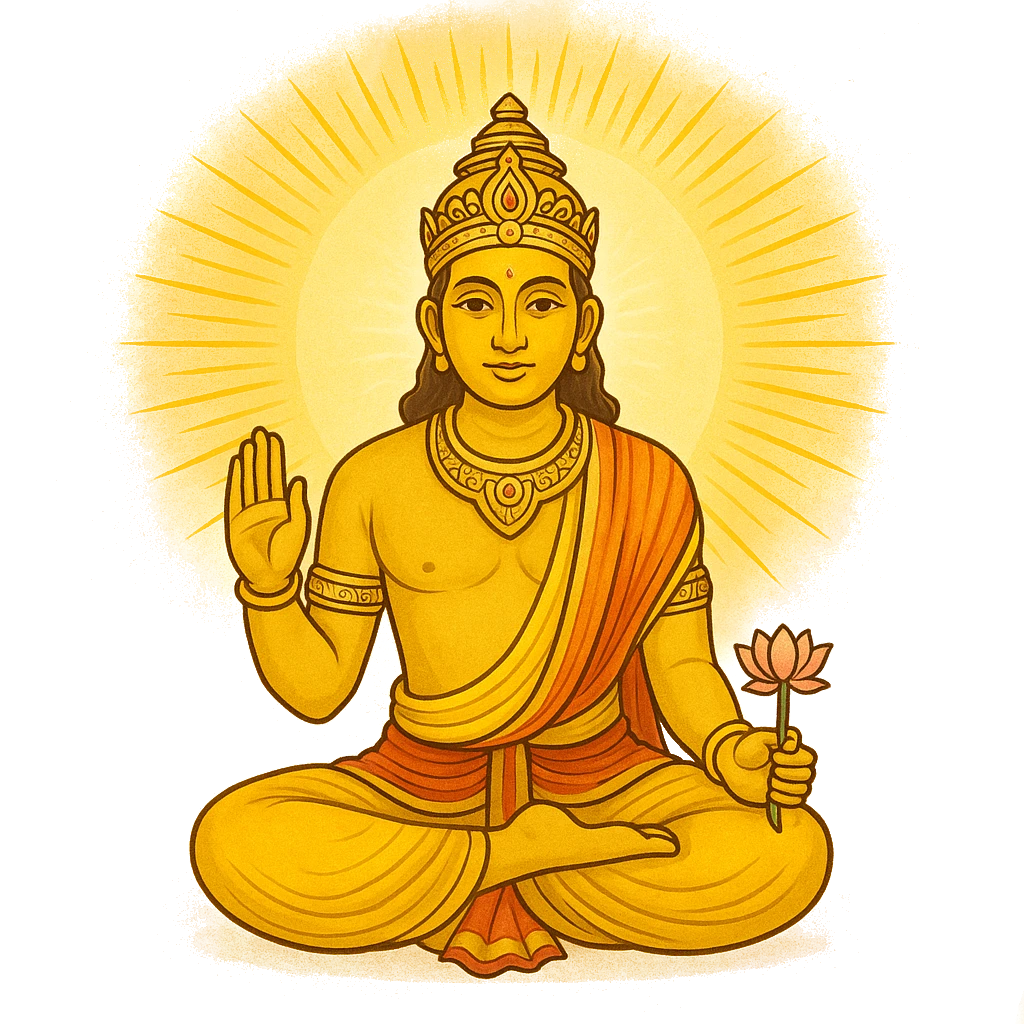
The Gayatri Mantra begins with a radiant invocation:
“Tat Savitur Vareṇyaṁ”
— That most excellent light of Savitṛ, we meditate upon.
To understand the power and purpose of Gayatri,
one must dive deep into the solar origins of the mantra and the mysterious deity Savitṛ,
from whom all vitality, awareness, and evolution arise.
This chapter is a journey through solar cosmology,
inner illumination, and the mythic, metaphysical role of Savitṛ
— the sun as both celestial body and divine principle.
We explore how this solar force is more than physical light
— it is the awakening spark of consciousness itself.
Who is Savitṛ? The Vedic Solar Divinity
In the Rig Veda, Savitṛ is not simply the sun (Sūrya) as it appears in the sky.
Savitṛ is the hidden sun, the source of solar intelligence,
the divine impulse that sets all life into motion.
He is called:
Prajāpati – Lord of creation
Hiraṇyagarbha – The golden embryo
The Light behind the Sun – the sun before sunrise, the force behind action
Whereas Sūrya is the visible sun,
Savitṛ is the animating essence,
the deva that “impels” (prachodayāt)
all beings to move, grow, know, and transcend.
Thus, the Gayatri mantra is not worshiping a burning ball of gas,
but the cosmic force of divine cognition
— the solar Logos that awakens higher perception.
Solar Symbolism in the Vedas and Tantra
Across Vedic texts and later Tantras, the sun symbolizes five key principles:
Light as Awareness – The sun represents clarity, truth, and seeing beyond illusion
Heat as Purification – Solar energy burns away ignorance and karmic residue
Radiance as Presence – The sun shines equally on all; it is non-dual compassion
Cycle as Dharma – Sunrise and sunset are reminders of birth, death, and rebirth
Center as Source – Like the sun at the center of the solar system,
the Self is at the center of all experience
Savitṛ is invoked to ignite these principles within.
The mantra is a request not for outer light alone,
but for inner vision — the eye behind the eye.
The Inner Sun (Āditya) and Spiritual Evolution
In yogic anatomy, there is a surya nāḍi (solar nerve channel)
running along the right side of the spine,
balancing the chandra nāḍi (lunar channel) on the left.
The sushumṇā, the central channel, is activated when these two are harmonized.
Savitṛ's light is invoked to:
Awaken the third eye
Illuminate the sushumṇā
Energize the heart (anāhata) and navel (maṇipūra) centers
Transmute prāṇa into ojas (refined spiritual energy)
This inner alchemy makes Gayatri a solar kriyā,
a transformative rite encoded into sound.
Gayatri as Solar Alchemy
Each syllable of Gayatri can be seen as a ray of Savitṛ’s light:
“Tat” = That (pure awareness)
“Savitur” = of the solar deity
“Vareṇyaṁ” = most excellent, most desirable
The rest of the mantra requests that this light:
Bhargo = divine effulgence
Devasya = of the deity
Dhīmahi = we meditate upon
Dhiyo yo naḥ prachodayāt = may it inspire our intellects
This is not mere praise — it is transmission. Gayatri becomes a vehicle of solar codes
— awakening the buddhi (intuitive intelligence)
and aligning the practitioner with rta, the cosmic order.
Mythic Dimensions: Savitṛ, Surya, and the Chariot
In Vedic hymns, Savitṛ is depicted as riding a golden chariot drawn by seven horses.
These symbolize:
The seven meters (chandas) of Vedic poetry
The seven rays or colors of light
The seven levels of consciousness or lokas
The seven chakras
The chariot is the mind; the horses are the senses; the reins are mantra;
the charioteer is Savitṛ guiding us back to the Self.
In this myth, the practitioner becomes Arjuna, and the inner Savitṛ becomes Krishna
— the inner charioteer of wisdom.
Solar Practices and Gayatri
Sūrya Trāṭaka (Sun Gazing)
Practice at sunrise/sunset
Gaze at the sun softly while chanting Gayatri mentally
Absorb light through the third eye
Surya Namaskar + Mantra
Pair sun salutations with repetitions of the Gayatri
Synchronize breath, movement, and syllables
Solar Prāṇāyāma
Inhale through right nostril (pingala)
Hold with the mantra
Exhale through left nostril
Solar Visualization
Visualize a sun in the heart
Each mantra repetition sends a ray through the body
These practices energize, purify, and illumine the subtle system.
Savitṛ and the Golden Womb
The Ṛg Veda speaks of Hiraṇyagarbha — the golden embryo — as the source of creation.
This golden light is the seed of the universe, and Savitṛ is its first pulse.
In meditation, the bindu of the Śrī Yantra becomes the golden sun of awareness
— the first form, the light that sees and knows.
Gayatri links us to this origin point, not as a concept, but as a living frequency.
To chant her is to spiral inward toward this golden seed
— to remember that we too were born of light.
Final Insight: Becoming a Sun
The true aim of Gayatri is not only to receive light, but to become light.
Just as the sun gives without seeking
Just as it shines on all without judgment
Just as it burns away illusion with clarity
...so too can the awakened being radiate love, wisdom, and presence.
To invoke Savitṛ is to invoke the solar principle within
— the ability to illuminate one’s own path and warm others through presence.
The mantra, the sun, the Self — all merge in that golden pulse.
Gayatri is not only praise of the sun — she is its reflection in you.
Chapter 11 -Agni – Inner Fire & Illumination
Part 6: Inner Alchemy
Agni – Inner Fire, Illumination, and the Alchemy of Breath

In the earliest hymns of the Ṛg Veda, the very first word uttered is Agni — the sacred fire.
More than a physical flame, Agni is the divine spark, the carrier of offerings, the bridge between worlds.
He is the priest, the altar, and the fire itself.
Without Agni, no sacrifice reaches the gods, no mantra bears fruit, no transformation occurs.
For the seeker of Gayatri, Agni is not only a Vedic deity — he is a metaphysical principle,
the internal flame of awareness, and the power that burns ignorance into light.
This chapter explores how Agni lives in the breath, in the mantra, and in the heart
— guiding transformation through devotion, discipline, and inner heat.
Agni in the Vedas: The First God
Agni is invoked in over 200 hymns of the Ṛg Veda, making him the most celebrated deity in the text. He is:
Jātavedas – the knower of all births
Hotṛ – the sacrificial priest
Vahni – the carrier of offerings
Vaishvānara – the universal flame in all beings
Agni dwells in:
The sun (celestial fire)
Lightning (atmospheric fire)
Flame (terrestrial fire)
Digestion (bodily fire)
Awareness (spiritual fire)
He is the messenger between humans and gods — what is offered into Agni rises upward and transforms.
Agni and the Inner Body: The Fire Triangle
In the subtle yogic body, Agni governs three central areas:
Maṇipūra Chakra (Navel)
Fire of digestion (Jāṭharāgni)
Willpower, clarity, discipline
Seat of personal transformation
Heart Flame (Anāhata)
Flame of devotion and compassion
Warms and purifies emotional energy
Agni becomes Homa — sacred heart offering
Third Eye (Ājñā Chakra)
Flame of insight
Inner light that sees through illusion
Source of higher discernment
Agni travels upward as the Kundalini Fire,
spiraling through the central channel (sushumṇā), purifying as it ascends.
Gayatri and Agni: The Fire of Illumination
Gayatri, as a mantra of light, is inseparable from Agni.
She is not chanted to Agni, she is carried by him.
Her syllables are fuel.
Her rhythm is the ritual. Her recitation is the fire.
Each of her 24 syllables becomes:
An oblation offered into inner silence
A spark that ignites dormant energies
A flame that consumes confusion
In this sense, chanting Gayatri becomes a daily inner yajña (sacrifice).
The seeker becomes the fire altar.
The breath becomes the wind. The ego becomes the ghee.
And the light of insight is born.
The Breath as Carrier of Fire (Prāṇa = Agni)
In yogic science, prāṇa is not merely air — it is life-current, and it carries Agni within it.
Five Vayus (Inner Winds):
Prāṇa – Inhalation, heart-centered, upward
Apāna – Elimination, downward
Samāna – Digestion, centered in navel — seat of Agni
Udāna – Speech and upward energy
Vyāna – Circulation throughout body
Through breath control (prāṇāyāma), Agni is stoked and made radiant:
Slow inhale = gathering fuel
Retention = fanning the flame
Exhale = releasing purified energy
Each breath, when synchronized with mantra, becomes a sacred offering.
Agni as Inner Alchemy (Tapas & Svādhyāya)
Agni is the principle behind:
Tapas – inner heat generated by discipline and austerity
Svādhyāya – sacred self-inquiry; burning ignorance through knowledge
Bhakti – devotion that consumes identity and separation
These three — Tapas, Svādhyāya, and Bhakti
— are the three flames of inner alchemy. Together they:
Burn away karmic residue
Refine lower desires into divine aspiration
Transform mantra from sound into realization
The practitioner becomes like gold in a crucible
— what is not essential is melted away.
Sacred Fire Practices with Gayatri
Inner Homa Meditation
Visualize a fire at the navel
With each syllable of Gayatri, offer a thought, attachment, or fear
Trikāgni Visualization (Three Fires)
Navel: digestive fire
Heart: devotional flame
Brow: illumination
Chant Gayatri, moving awareness through all three
Prāṇāyāma with Mantra
Inhale: Om Bhur Bhuvaḥ
Retain: Svaḥ Tat Savitur
Exhale: Vareṇyaṁ Bhargo Devasya Dhīmahi
Retain (after exhale): Dhiyo Yo Naḥ Prachodayāt
Real Fire Ritual (Yajña)
Use ghee, herbs, or symbolic offerings
Recite Gayatri with each offering
Visualize the outer flame as your inner self
Final Insight: Becoming the Flame
Agni is not something to be worshipped outside — he is to be realized inside.
He is the drive to seek, the will to change, the power to endure.
He is the flame in your eyes, the spark in your breath, the warmth of realization.
Gayatri does not teach us to praise the light — she teaches us to be it.
When fire and mantra meet, awareness is forged anew.
To walk the Gayatri path is to carry a flame.
To offer everything false into it. And to let only the essential remain — luminous, silent, eternal.
Breath as Goddess – Prāṇa, Śakti, and the Living Mantra
Among the most sacred and overlooked aspects of the Gayatri tradition is the breath.
In yogic and Tantric systems, breath is not merely air
— it is the manifestation of Shakti, the divine current that animates all things.
Known as prāṇa, it is the subtle energy behind thought, action, sensation, and even awareness.
This chapter explores how breath is the vehicle of the mantra,
the carrier of fire (Agni), the dance of Shakti, and the gateway to awakening.
When aligned with Gayatri, it becomes the living presence of the goddess herself
— whispering realization into every cell.
Prāṇa – The Goddess in Motion
In Sanskrit, "prāṇa" means life force or vital wind.
It is said that when prāṇa leaves the body, life ceases.
But prāṇa is not physical oxygen — it is conscious vitality, carried on the breath but subtler than it.
In Tantra and Vedānta, prāṇa is:
The movement of Śakti (divine energy)
The link between body and mind
The thread connecting gross and subtle realms
When breath is unconscious, life is mechanical. When breath is conscious, life becomes sacred.
Five Vayus – The Winds Within
Prāṇa divides itself into five major vayus (winds) that govern all bodily and spiritual functions:
Prāṇa Vayu – Inhalation, centered in chest; draws energy in
Apāna Vayu – Exhalation and elimination; rooted in lower abdomen
Samāna Vayu – Assimilation, centered in navel; digestion and balance
Udāna Vayu – Upward movement; speech, throat, and rising energy
Vyāna Vayu – Circulation throughout; peripheral awareness
These five are the fingers of the goddess, constantly weaving experience.
In breathwork, mantra recitation, and visualization, we refine these winds into clarity.
Gayatri as Breath – The Pulse of the Goddess
The Gayatri mantra is traditionally chanted in rhythm with the breath.
In doing so, the mantra enters not just the mind but the nervous system, the cells, and the energetic body.
A powerful Gayatri breathing pattern:
Inhale: Om Bhur Bhuvaḥ Svaḥ
Hold (Antar Kumbhaka): Tat Savitur Vareṇyaṁ
Exhale: Bhargo Devasya Dhīmahi
Hold (Bahya Kumbhaka): Dhiyo Yo Naḥ Prachodayāt
This transforms the chant into a living breath-ritual, aligning body, mind, and soul.
Each line maps to a pranic function:
Inhale: drawing light
Retention: focusing it in the heart
Exhale: radiating it through the system
Post-exhalation: resting in stillness
Breath as Mantra, Breath as Guru
When one meditates on breath without controlling it, it reveals a natural rhythm
— Ajapa Japa, the automatic mantra. In this:
Inhale silently says “So”
Exhale silently says “Ham”
This So'Ham (“I am That”) becomes a continuous Gayatri
— an affirmation that the breath itself is the divine mantra.
The Upanishads say: “Prāṇo vai Brahma” — prāṇa is Brahman.
Thus, breath is not just the vehicle — it is the destination.
To follow the breath to its source is to discover the silent, eternal presence behind all motion.
In this sense, the breath becomes the inner guru — guiding, refining, awakening.
Practices: Gayatri Prāṇāyāma and Breath Sādhanas
Sama Vṛtti (Equal Breath) with Mantra
Inhale 4 counts: Om Bhur Bhuvaḥ Svaḥ
Hold 4 counts: Tat Savitur Vareṇyaṁ
Exhale 4 counts: Bhargo Devasya Dhīmahi
Hold 4 counts: Dhiyo Yo Naḥ Prachodayāt
Repeat for 12 rounds
Nādī Śuddhi with Gayatri
Alternate nostrils (left in, right out, etc.)
Mental repetition of mantra with each breath
Clears channels, balances prāṇa
Inner Light Breath
Visualize golden light entering crown
With each breath, send it through the body
Chant Gayatri softly or mentally as it moves
Breath Inquiry
Sit in silence
Watch breath arise and dissolve
Ask: Who breathes this breath?
Final Insight: The Goddess Who Breathes You
In the most refined vision, you do not breathe — you are being breathed.
The breath is not yours — it is hers.
Gayatri becomes the rhythm of existence:
She breathes into form
She breathes out of form
In between, she reveals the stillness of Self
To chant Gayatri is to align with this cosmic breath
— to recognize that every inhalation is the coming of light,
every exhalation the offering of self, and every pause the glimpse of the infinite.
Thus, breath becomes mantra.
Mantra becomes goddess.
Goddess becomes you.
Chapter 12 -Gayatri and Sound Healing
Gayatri and Sound Healing – The Vibrational Body of Consciousness
In the deepest streams of yogic and tantric philosophy, sound is not a byproduct of creation — it is the cause.
The cosmos did not emerge with sound — it is sound.
Every object, emotion, and even thought is a condensation of subtle vibration.
This is why mantras are not simply sacred words, but formulas of frequency.
Among them, the Gayatri Mantra is perhaps the most refined and luminous.
This chapter explores the healing dimension of Gayatri, uncovering how its vibration affects the body, mind, subtle field, and karmic impressions.
To chant Gayatri is to tune the instrument of the self — recalibrating health, clarity, and harmony.
The Universe is Made of Sound
In Vedic cosmology:
Śabda Brahman means: sound is the Absolute
The first ripple of consciousness is Nāda — sound
Form arises from Bindu (point), activated by Nāda
This cosmology is also an anatomy:
Body = vessel
Chakras = frequency centers
Prāṇa = vibratory current
Mantra = tuning fork
Everything has a signature vibration. Dis-ease occurs when vibrations are incoherent. Mantra restores resonance.
Gayatri as a Sonic Elixir
Gayatri is constructed with perfect chandas (meter) and phonetic symmetry:
24 syllables in 8-8-8 triplets
Each syllable activates a petal of a subtle lotus
Her sound harmonizes three realms: bhūr (body), bhuvaḥ (mind), svaḥ (spirit)
When chanted:
The tongue taps pressure points on the palate
The brain hemispheres synchronize
The vagus nerve is stimulated
The cellular waters resonate
Gayatri is not a chant — she is a sonic sculpture of healing intelligence.
Mantra and the Brain-Body Field
Scientific studies on mantra reveal:
Reduced cortisol (stress hormone)
Balanced heart-rate variability
Increased alpha and theta waves (meditative states)
Strengthened immune response
Each line of Gayatri can be mapped to neuro-energetic centers:
Om Bhūr Bhuvaḥ Svaḥ – Grounding and alignment (Root to Solar Plexus)
Tat Savitur Vareṇyaṁ – Solar infusion (Heart and Crown)
Bhargo Devasya Dhīmahi – Activation of inner light (Third Eye)
Dhiyo Yo Naḥ Prachodayāt – Illumined intellect and clarity (Higher Mind)
The rhythm of chanting creates entrainment — brainwaves match mantra frequency.
This resets patterns of anxiety, fatigue, and confusion.
Healing Through Subtle Sound
Sound bypasses the mind and enters the field:
Chanting Gayatri aloud purifies the air and aura
Whispering enters the nervous system
Mental recitation heals the subconscious
Silent awareness of mantra dissolves karmic threads
Different modes for different purposes:
Aloud = Energy clearing
Whisper = Body healing
Mental = Mind and emotions
Silent = Soul alignment
Gayatri heals by restoring dharma — harmony with inner nature.
Sound Healing Practices with Gayatri
Svara-based Chanting
Explore Gayatri on 3 tones: low (body), mid (heart), high (crown)
Each repetition is a chakra attunement
Tuning Bowl Resonance
Strike a Tibetan bowl tuned to C, D, or E
Chant one line per bowl vibration
Feel mantra ride the wave of sound
Water Charging Ritual
Fill a copper or glass vessel with water
Chant Gayatri over it 108 times
Drink the water as vibrational medicine
Healing Touch with Mantra
Lay hands on a part of the body needing care
Whisper Gayatri into the palm
Allow the vibration to enter through warmth and sound
Gayatri and Epigenetic Healing
Modern research shows that sound and intention can influence:
Gene expression
DNA repair enzymes
Emotional imprinting
Gayatri, when chanted with devotion and clarity, re-patterns inner programming.
It doesn’t only heal symptoms — it dissolves root dissonance.
When paired with affirmations like:
“I am light”
“My thoughts are sacred”
“This body is a temple”
Gayatri becomes the seed of spiritual biology — consciousness embedded in matter.
Final Insight: You Are Made of Song
Gayatri doesn’t just produce healing sound — she reveals that you are made of sound.
You are not a static being, but a symphony of vibrations.
Your pain is a dissonant chord. Your joy is harmony. Your dharma is your melody.
When you chant Gayatri:
You are not asking for healing — you are becoming the healer
You are not fixing brokenness — you are restoring rhythm
You are not just invoking a goddess — you are tuning into her frequency
She sings you into coherence.
She chants you back into Self.
In the beginning was the sound.
Now, you become the echo.
Chapter 13 -The Mythos of Gayatri -Part 1
The Mythos of Gayatri – Part 1
Light, Sound, and the Eternal Feminine
SECTIONS: 1 - 6
In the landscape of Indian spiritual thought, the name "Gayatri" evokes reverence, radiance, and transformation.
She is not merely a mantra or a goddess—she is the convergence point where sound becomes deity,
light becomes wisdom, and mantra becomes consciousness.
This expanded chapter dives into the rich,
multifaceted mythology and symbolic layers surrounding Gayatri across Vedic, Puranic, Tantric, and folk traditions.
Each section below reveals a different aspect of her eternal play.
Section 1: Gayatri Saves the Yajna – Completing Creation
In one of the earliest symbolic stories preserved in the Puranic traditions—echoing Vedic cosmology
—Brahma, the Creator, begins a great yajna (sacrificial ritual) at the dawn of time to initiate creation.
This ritual represents not just fire offering, but the conscious setting into motion of the cycles of existence.
Yet, according to several Purāṇas (such as the Brahmavaivarta Purāṇa and Devi Bhāgavata Purāṇa),
Brahma’s wife Saraswati, embodiment of wisdom and speech,
refuses to participate due to his prior moral transgression or imbalanced intention.
Without a feminine force to empower the yajna, it falters.
The sacrifice remains incomplete. The universe cannot begin.
To resolve this, Brahma invokes from the heart of the ether
—from the womb of space itself (Ākāśa)—a luminous goddess: Gayatri.
She is born of mantra, from the vibration of divine will itself.
Described as brilliant, youthful, adorned with celestial radiance,
Gayatri appears, seated upon a swan or lion, holding water pot, mala, lotus, and scripture.
With Gayatri’s presence, the yajna proceeds. The flames rise. The mantras ignite the cosmos.
Through her voice, Brahma completes the ritual, and creation begins to manifest.
Saraswati, furious at being replaced, curses Brahma.
But Gayatri, possessing supreme knowledge and compassion, stabilizes the sacrifice,
neutralizes the curse’s harm, and restores order to the universe. She reconciles creation with dharma.
Devi Bhāgavata Purāṇa (Skandha 9) suggests: "Gayatri, in truth, is the Veda itself embodied.
She is speech, she is action, she is the light of sacrifice."
🕉️ Spiritual Insight
Gayatri is not just a helper or consort — she is the vibrational intelligence that gives life to spiritual intention.
Just as fire needs air to burn, will (Brahma) requires sound-energy (Shakti) to create.
She is the first resonance within the void — the Śabda Brahman that bridges potential and form.
Tantric Interpretation
In Tantric symbolism, the yajna altar is the subtle body.
Brahma symbolizes pure will (icchā śakti).
Saraswati is jnāna śakti (wisdom) withheld.
Gayatri is the kundalini force that must rise and express to activate the inner fire.
This myth becomes a psychological map:
when intention is blocked by inner resistance, one must awaken Gayatri
— the clarity and power to complete one’s internal offering.
Practice: Gayatri-Yajna Visualization
Visualize your body as a sacred altar
Breathe into your heart center, visualizing a soft golden flame
Silently chant: Om Bhur Bhuvah Svah...
With each syllable, offer a “blockage” into the fire
End with silence, letting Gayatri’s energy dissolve into space
Section 2: Gayatri as the Fifth Wife of Brahma — Wrath, Curse, and Cosmic Rebalancing
“The gods are not perfect. They too are subject to longing and law.
When wisdom withdraws, it is Shakti who steps forward to restore the rhythm.”
In the first cycles of time, before the world had shape, Brahma sat alone, immersed in potential.
His mind stirred with the desire to create.
From this stirring, Saraswati emerged — not just a daughter, but an extension of his own intelligence,
born of his longing to articulate the unmanifest.
He beheld her — luminous, self-born, unspeakably beautiful.
And in that beholding, desire overtook discernment. Saraswati turned away.
She was not his to possess, only to receive — as inspiration, as rhythm, as flow.
But Brahma, maddened by his own projection,
pursued her across the directions, sprouting heads to follow her movement:
east, west, north, south, and finally upward. A fifth head crowned him, born of obsession.
Creation stalled. The wisdom he had birthed refused to collaborate.
And so, Saraswati spoke. A curse, not from hatred, but from refusal:
“Because you have broken the sanctity of your own gaze, you shall not be worshipped on Earth.”
And with that, she withdrew her presence — from his side, from the yajña fire, from the creative process itself.
Creation trembled. The rituals could not proceed. Brahma, abandoned by his own Śakti,
sat incomplete — power without presence, form without flow.
It was then that Gayatri appeared.
Not from his body, but from the Vedic breath of the Earth, she rose — wild-haired, dark-eyed, wrapped in syllables.
Some say she was a tribal girl of untamed forests; others say she was Veda personified, the meter of sacred speech come alive.
Where Saraswati denied, Gayatri descended.
She approached the halted yajña not with accusation, but with alignment.
She did not come to compete with Saraswati, but to complete what had been broken.
With a voice clear as the river’s origin, she intoned the mantra of restoration.
She stepped beside Brahma not as possession, but as priestess, seer, and partner of rhythm.
With her, the ritual resumed. Creation exhaled.
Two Shaktis: The Withholding and the Healing
Where Saraswati is the discerning intellect that withdraws when purity is violated,
Gayatri is the healing rhythm that returns not to excuse, but to redeem.
The curse is not undone, but transmuted — not by force, but by song.
Saraswati’s wrath is the power of sacred boundary.
Gayatri’s grace is the power of sacred restoration.
In this myth, we do not see “good goddess vs. bad goddess,”
but two movements of feminine force: one that guards, and one that offers again.
Saraswati teaches Brahma that knowledge cannot be coerced.
Gayatri teaches Brahma that wisdom, once surrendered to, will still guide the fire.
Theological Implication: The God Who Is Not Worshipped
Brahma’s curse holds: to this day, there are few temples to his name.
He is rarely invoked as a personal deity. His act of creation is overshadowed by the violation at its root.
But Gayatri is worshipped. Repeated. Installed in hearts and homes.
This reversal is not incidental.
The feminine agent of correction becomes the feminine object of devotion.
Gayatri does not erase Brahma’s error — she teaches how to continue despite it.
She stands for the resilience of the sacred after rupture.
Tantric Reflection: Shakti as Restorer of Dharma
In the subtle body, Brahma is the head — the generator of thought.
Saraswati is the brow — insight and vision.
When insight turns away, thought collapses into self-reference.
Gayatri, then, is the breath — the downward movement into rhythmic embodiment.
She enters not through the intellect, but through mantra, pulse, and breath.
She reinitiates the ritual of life from below.
This is the secret: the divine feminine returns not through the heights,
but through the ground — through earth, sound, and surrender.
Closing Invocation
Salutations to She who entered when wisdom withdrew,
Who sang the world back into rhythm,
Whose forgiveness is not forgetfulness,
But the return of flow.
O Gayatri, Fifth Flame of the Creator,
May we know not only the mantras,
But the silence that follows when wisdom departs.
And the grace that enters to restore it.
Section 3: Gayatri and Saraswati — The Split of Wisdom and Power
“There are times when the One becomes Two — when knowledge and will, insight and expression, refuse to sit in the same room.”
After the fire was restored and creation resumed, the wound remained
— not just in Brahma, but in the very architecture of wisdom.
Saraswati did not return to Brahma’s side.
She continued her path alone
— as the river of speech, the stream of higher knowledge, the quiet clarity of insight untouched by desire.
Gayatri, meanwhile, took her place at the fire
— illuminating Vedic chants, harmonizing ritual, guiding the sacred syllables of becoming.
She became the power of manifestation, of utterance, of transmission.
Thus the two sisters — or perhaps the two faces of one Shakti — went their separate ways.
One withheld.
One offered.
One guarded vision.
One gave it voice.
The Divided Feminine
The Purāṇic texts do not reconcile the rupture between Saraswati and Gayatri. But the tantric seers do
— not by forcing unity, but by recognizing a polarity within consciousness itself.
In the inner temple of the psyche, Saraswati and Gayatri represent two essential functions:
Saraswati: the keeper of insight, discernment, abstract intelligence
Gayatri: the force of expression, rhythm, and embodied knowledge
When united, they produce radiant clarity — insight flowing into word, idea taking shape in breath.
When split, we experience one of two imbalances:
Saraswati without Gayatri: silent knowing that cannot speak — insight trapped in abstraction
Gayatri without Saraswati: empty eloquence — sound without meaning, ritual without realization
This split is not mythological alone — it is experiential, known to every seeker.
We sense Saraswati in the stillness behind our thoughts.
We sense Gayatri when words flow effortlessly from the heart.
Both are needed.
And when they separate, the world falters.
Four Levels of Vāk — The Hidden Dialogue
In Vāk tantra, the speech goddess is said to move through four stages:
Parā – the unspoken, pure awareness
Paśyantī – the visionary impulse, like Saraswati
Madhyamā – the shaping of thought, the inner word
Vaikharī – the spoken sound, like Gayatri
The rupture between Saraswati and Gayatri is the rift between Paśyantī and Vaikharī
— between vision and utterance.
Saraswati lingers in the subtle field.
Gayatri descends into form.
When speech becomes hollow, it is because Saraswati has withdrawn.
When insight remains unshared, it is because Gayatri has not awakened.
Together, they are the current of awakened Vāk.
Apart, they are tension — one in silence, one in song.
Tantric Integration: Reuniting the Shaktis
The path of mantra sādhanā is not just repetition — it is the ritual rejoining of Saraswati and Gayatri within the self.
Every pause before the mantra begins — is Saraswati.
Every syllable that follows — is Gayatri.
The breath that carries them — is their union.
When you chant with full awareness, Saraswati listens from within, and Gayatri speaks through you.
To know Gayatri deeply is not to abandon Saraswati — but to call her back, to marry sound with silence, expression with essence.
Closing Reflection
They are not rivals, but riven halves of the same Shakti
—the eye and the voice, the gaze and the breath.
When they rejoin, mantra becomes revelation.
Speech becomes wisdom. Wisdom becomes sound.
Section 4 Gayatri as Vedamata – The Mother of the Vedas
Introduction: The Divine Origin of Sound
In Vedic and Upanishadic cosmology, sound (śabda) is not simply vibration.
It is primordial order — Rta — manifested as speech, meaning, rhythm, and truth.
The Gayatri Mantra is considered the quintessential crystallization of Vedic sound,
containing within it all meters (chandas), wisdom (vidyā), and deities (devatāḥ).
As such, she is not only a goddess, but Vedamata — the Mother of the Vedas.
This is more than a title. It reflects a metaphysical role.
She is the power of revelation, that force within awareness that allows truth to be heard.
Scriptural References to Gayatri as Vedamata
Chāndogya Upanishad (3.12.1):
गायत्री वै इदं सर्वं, भूतं यदिदं किञ्च, तत् गायत्र्यैव।
Gayatrī vai idaṃ sarvaṃ, bhūtaṃ yad idaṃ kiñ ca, tat gayatry eva.
Translation: “Gayatri is indeed all this, whatever exists here.
Everything that exists is nothing but Gayatri.”
Here, Gayatri is described as the substratum of reality.
She is the unifying consciousness behind all phenomena — from the subtlest breath to the vast cosmos.
Mahābhārata – Śānti Parva (343.91):
“The Gayatri is the mother of the Vedas. She is eternal, auspicious, and the root of all knowledge.
The wise who recite her rise beyond sin and darkness.”
This elevates Gayatri to eternal metaphysical source. She does not merely contain the Vedas — she precedes them.
The mantra is both the seed and soil of sacred knowledge.
Gayatri Tantra:
“She who is uttered in three lines, by seven meters, with 24 syllables — that Devi is eternal Veda.”
Here, the mantra itself is treated as a deity-body, with syllables corresponding to divine limbs and cosmic attributes.
Symbolic Breakdown of the Gayatri Mantra
The Gayatri Mantra:
ॐ भूर्भुवः सुवः
तत्सवितुर्वरेण्यं
भर्गो देवस्य धीमहि
धियो यो नः प्रचोदयात्
🔹 Bhūr – Earth / Physical world / Rig Veda
🔹 Bhuvaḥ – Atmosphere / Energy / Yajur Veda
🔹 Svaḥ – Heaven / Intention / Sama Veda
The mantra’s three lines reflect the tripartite vision of existence.
These map directly onto the three main Vedas,
and their resonance becomes a bridge between human and divine perception.
24 syllables = 24 tattvas (principles of manifestation)
3 lines = 3 states of consciousness
7 meters (chandas) = 7 layers of speech & perception
Thus, Gayatri is not just mother of the Vedas — she is the Vedas in seed form.
Philosophical Interpretation
In Vedanta, truth (satya) is not learned but revealed. This is the heart of the concept of śruti — “that which is heard.”
The Rishis did not invent the Vedas; they heard them in heightened states of consciousness.
Gayatri is the inner field of silence that makes such hearing possible.
She is speech before speech. When consciousness looks within and receives its own voice — that’s Gayatri revealing herself.
Tantric Interpretation
In Sri Vidya and other Tantric systems, Gayatri is identified with Kundalini Shakti.
The 24 syllables activate specific centers in the subtle body (sūkṣma śarīra).
Each syllable is visualized as a petal in a 3-ringed lotus around the heart or crown.
The chanting of Gayatri awakens:
Nāda: Subtle sound
Bindu: Point of origin
Kāla: Time-energy flow
Śakti: Conscious dynamic intelligence
Thus, chanting Gayatri is an alchemical act — transforming lower mental frequencies into divine cognition.
Practice: Inner Hearing Meditation
This practice allows you to experience Gayatri as inner revelation.
Sit in silence, spine aligned, gaze inward at heart center
Inhale slowly, mentally chant: Tat-Savitūr-Vareṇyam...
As the breath holds, listen to the space between syllables
Exhale into silence — let the mantra dissolve
Rest in the resonant echo of awareness
Repeat 7 times. Let the mantra lead you into the source of knowing.
Summary
Gayatri as Vedamata is more than a symbolic mother. She is the field of pure potentiality,
the living resonance through which all sacred wisdom emerges.
Her 24 syllables are cosmic seeds, each containing:
A deity
A world
A frequency of realization
To chant her is to enter the vibrational matrix of reality
— where mantra and meaning, form and formlessness, goddess and self, are one.
Section 5: Tripura Sundari as Inner Gayatri
Among all the luminous forms associated with Gayatri, none shines more radiantly at the heart of her mysticism
than Tripura Sundari — the "Beauty of the Three Worlds."
She is not only the central face of five-faced Gayatri but is also considered the embodied consciousness
that governs the triadic realms of existence: gross, subtle, and causal.
She is the inner essence of Gayatri, and the true destination of the mantra’s journey.
In Tantric cosmology, Tripura Sundari is the fusion of Shiva and Shakti, awareness and bliss, form and formlessness.
She is the smiling face of divinity in the midst of samsara — beauty, wisdom, and presence unified.
Scriptural and Tantric References
In the Tripura Rahasya, a foundational text of the Sri Vidya tradition, Tripura Sundari is described not as an external deity
but as the inner witness who appears once the mind becomes still:
“She is consciousness. She is supreme peace. She is the substratum of all.”
In the Lalita Sahasranama (her thousand names), she is described as:
“Chidagni-kunda-sambhūta” – Born from the fire-pit of consciousness
“Tripura” – She who pervades the three cities/states
“Sundari” – The beautiful one, embodying blissful awareness
These references place her not just at the periphery of divine mythos,
but at its very center — as the secret inner radiance behind all forms of mantra, goddess, and self.
Tripura and the Three Worlds
“Tri-pura” literally means “three cities,” but symbolically, it refers to:
Bhur (Physical/Gross Plane) – The waking state, bodily awareness
Bhuvah (Subtle Plane) – The dream state, mental and emotional activity
Svah (Causal Plane) – The deep sleep state, unmanifest impressions
Tripura Sundari governs all three states while simultaneously transcending them.
Her realm is Turiya — the fourth state, which underlies and witnesses the other three.
In this sense, she is Gayatri in her purest form: not merely the chanted syllables, but the awareness through which they are known.
Gayatri’s Inner Face
Gayatri’s mantra — especially its last line:
धियो यो नः प्रचोदयात् (dhiyo yo naḥ pracodayāt)
“May she enlighten our intellects”
— is a direct appeal to Tripura Sundari as Maha-Vidya (Great Wisdom).
She is the light behind thought, the intelligence that enlivens the buddhi, and the pleasure of resting in pure, self-aware being.
In Sri Chakra, the sacred geometric form of the goddess, Tripura Sundari sits at the bindu
— the central point from which all creation radiates and to which all dissolves.
This is not just a metaphysical symbol; it is a meditative realization
— that the core of all being is non-dual awareness infused with bliss.
Inner Alchemy of Form and Consciousness
Tripura Sundari’s name implies an alchemical vision — she reconciles opposites:
Duality Reconciliation in Tripura Sundari
Shiva (Consciousness) Awareness made intimate
Shakti (Energy) Power guided by stillness
Beauty (Rūpa) Form without clinging
Wisdom (Vidya) Insight beyond reason
Bliss (Ānanda) The fruit of self-realization
Thus, she is the mantra, the reciter, the listener, and the goal. Every sound in Gayatri leads inward to her throne.
Meditation: “Tripura Hridaya Dharana” (Heart of Tripura Contemplation)
Sit in a peaceful space. Close the eyes and breathe slowly.
Inhale: Visualize a red lotus at the heart center (anāhata), pulsing with light.
Exhale: Whisper the mantra “Om Aim Hrim Shrim Tripurasundaryai Namah”
Feel the awareness of breath and mantra merge into one radiant presence.
Rest in the center of this inner lotus — no effort, only receptivity.
Feel the mantra disappear into silence, leaving awareness shining.
Repeat for 7 minutes or 108 breaths.
Symbols of Tripura Sundari
Red Lotus – blossoming of bliss-consciousness
Sugarcane Bow & Flower Arrows – Mind and senses drawn to beauty
Mirror – She reflects the Self as it truly is
Sri Chakra – The body of the cosmos and the soul’s path inward
Smile – Her most secret weapon; melting duality in sweetness
She does not frighten the ego into dissolving like Kali — she lures it lovingly, until it surrenders willingly into unity.
Summary
Tripura Sundari is not a remote deity — she is the innermost face of Gayatri, the one who dwells within the breath,
the syllables, the stillness between sounds.
She is:
The goal of mantra
The bliss of realization
The awareness that watches awareness itself
When Gayatri is chanted with full presence, it is Tripura Sundari who answers, not with thunder
— but with the gentle touch of awakening.
To know her is to dwell always in the center — where mantra, mind, and meaning dissolve into pure being.
Section 6: Gayatri and Time — Kali and Kala
The Gayatri Mantra is not only a hymn to light and knowledge
— it is a mantric vehicle that moves through the river of time, across the three worlds and three states of consciousness.
At its deepest layers, Gayatri is intimately connected to Kāla (Time) and the goddess Kālī,
who personifies the power to transcend and devour time itself.
Together, Kali and Kala form the boundary and the breakthrough: time as limitation, and time as gateway.
In the heart of this paradox stands Gayatri — whose rhythm mirrors time, but whose essence moves beyond it.
Time in Vedic Thought
In the Rigveda, time is not linear but cyclical — a great wheel (chakra) turning endlessly.
Days, seasons, lifetimes, and yugas unfold like mantra meters — repeating, yet revealing.
“Kālaḥ jagat bhakṣakaḥ” – “Time devours the world.”
– Mahābhārata
But what devours time?
According to tantric and Shakta texts, Kālī does.
She is Maha-Kali, the devourer of yugas, the dancer on the corpse of stillness.
And yet, she is also the protective mother, who liberates through this devouring.
Kali – The Shadow of Light
Kali is often misunderstood. Her dark skin, garland of skulls, lolling tongue, and blood-soaked tongue seem terrifying.
But these are not signs of destruction — they are symbols of total transformation:
Symbol Deeper Meaning
Black Skin The womb of the unmanifest — Ākāśa
Skulls Liberation from ego and illusion
Tongue Devouring the false self
Shiva beneath Stillness beneath the dance of time
In Gayatri's cosmology, Kali is the fire between syllables — the energy that clears karma, purifies thought, and burns away limitation.
“She is time, and she consumes time, and yet she is beyond time.”
– Kālī Tantra
The Rhythm of Time in Gayatri
The 24 syllables of Gayatri correspond to:
The 24 hours of the day
The 24 tattvas (principles of manifestation)
The movement of the sun across the zodiac
Each syllable becomes a tick of the cosmic clock, and as one chants,
the mantra aligns the soul to solar time — the rhythm of the inner sun.
But deeper than alignment is transcendence.
When Gayatri is chanted with full awareness, it becomes Ajapa Japa — the soundless sound,
beyond rhythm. In this moment, Kala ends, and Kali begins.
Kali and Turiya: The End of Time
Kali presides over the state of Turiya — the fourth state of consciousness beyond waking, dreaming, and deep sleep.
In waking, you are bound by the past.
In dreaming, time loops.
In deep sleep, time dissolves.
In Turiya, time never began.
Kali is the midnight sun, the moonless light that guides inward. She does not destroy to punish — she clears space for pure presence.
Gayatri offers light. Kali offers liberation from light and shadow.
Practice: Kali-Gayatri Fusion
Begin with 3 rounds of Gayatri mantra aloud
Close the eyes, visualize black flame rising in the spine
Chant silently: “Krīm Krīm Krīm” – the bīja of Kali
Feel the mantra rhythm slowing… then dissolving
Sit in silence — let all inner clocks stop
Whisper: “Who watches the watcher?” — rest in the answerless space
This practice harmonizes Gayatri’s radiant rhythm with Kali’s timeless void.
Tantric Symbolism
|
Principle |
Gayatri |
Kali |
|
Element |
Fire (Agni) |
Ether (Akasha) |
|
Sound |
Structured meter (24 syllables) |
Raw bīja (“Krīm”) |
|
Direction |
East (Sunrise) |
North (Night, Liberation) |
|
Chakra |
Heart & Crown |
Root & Third Eye |
|
Function |
Illumination, Realization |
Dissolution, Transcendence |
Kali is not separate from Gayatri — she is Gayatri in midnight form, hidden in the silence between syllables.
Summary
Kāla is the dance of time.
Kālī is the one who watches the dance — and ends it.
Gayatri is the mantra that moves through time to meet her.
When we chant Gayatri, we ride the wave of time.
When we meditate on Kali, we fall through it into the eternal.
Together, they form the complete yogic arc — from knowing the self,
to becoming that which is beyond knowing.
Chapter 14 -The Mythos of Gayatri -Part 2
The Mythos of Gayatri – Part 2
Light, Sound, and the Eternal Feminine
SECTIONS: 7 - 12
Section 7: Gayatri and the Inner Temple — Body as Mandala
In Vedic and Tantric traditions, the body is never regarded as an obstacle to realisation
— it is the temple of the Divine, the sacred geography where mantra, deity, and Self converge.
Within this embodied cosmos, the Gayatri Mantra becomes more than sound:
it is a sacred architecture — a mandala — vibrating through flesh, breath, mind, and soul.
This section explores how Gayatri maps onto the body, the subtle anatomy of chakras, nadis, and tattvas,
and how through mantra, the human form becomes a living altar.
The Temple Body in Indian Philosophy
Across Upanishadic and Tantric texts, we find repeated affirmations:
“Ya eṣo’ntar hṛdaye... sa vā eṣa ātmā”
(That which dwells in the heart — that indeed is the Self.)
– Chāndogya Upanishad
“Devo devalayaḥ proktaḥ jīvah kevalam arcayet”
(The body is the temple, the soul the deity. Worship must begin within.)
– Śaiva Agama
This recognition forms the foundation for mantra embodiment practices
— where every syllable, mudra, chakra, and breath becomes a ritual offering within the shrine of the body.
Mapping Gayatri Onto the Body
The 24 syllables of the Gayatri Mantra are traditionally assigned to 24 locations in the body
— from the crown to the soles of the feet.
🔹 Example Mapping:
|
Syllable |
Body Location |
Purpose |
|
Om |
Crown (Sahasrāra) |
Cosmic unity |
|
Bhur |
Forehead (Ājñā) |
Earth awareness |
|
Bhuvah |
Throat (Viśuddha) |
Vital force, prāṇa |
|
Svah |
Heart (Anāhata) |
Spiritual light |
|
Tat |
Solar plexus (Maṇipūra) |
Willpower |
|
Savitur |
Navel (Svādhiṣṭhāna) |
Source of creative flow |
|
Vareṇyam |
Root (Mūlādhāra) |
Anchoring, receptivity |
|
Bhargo |
Spine |
Illumination channel |
|
Devasya... |
Shoulders, arms, feet... |
Grounding and expansion |
Through nyāsa (placement), each syllable is mentally “installed” in the body.
This forms a mantric yantra — an energetic lotus of sound and meaning.
The Body as Gayatri Mandala
When visualized during meditation or mantra japa, the body transforms into a three-ringed lotus:
Inner Ring (8 syllables) – Chakras of perception and intellect
Middle Ring (8 syllables) – Chakras of emotion, breath, and heart
Outer Ring (8 syllables) – Chakras of embodiment, grounding, action
At the center lies Om Bhūr Bhuvaḥ Svaḥ — the threefold world, encoded into breath and posture.
This internal mandala is not merely imagined — through sustained practice, it becomes felt as vibration, as warmth, as spacious stillness.
Integration with Chakra System
|
Chakra |
Gayatri Aspect |
Deity / Energy |
|
Crown |
Om |
Unity, transcendence |
|
Third Eye |
Tat |
Light of discrimination |
|
Throat |
Savitur |
Inspired speech |
|
Heart |
Bhargo |
Compassionate illumination |
|
Solar Plexus |
Vareṇyam |
Radiant will |
|
Sacral |
Devasya |
Creative intelligence |
|
Root |
Dhiyo |
Grounded intellect |
Gayatri becomes a living breath spiral through these centers — turning the body into a vertical axis of evolution.
The Pranic Temple
The five prāṇas also correspond to parts of the mantra:
Prāṇa (upward-moving) – Linked to Bhargo, vital light
Apāna (downward) – Dhiyo, grounding intellect
Samāna (digestive) – Vareṇyam, inner fire
Udāna (ascending) – Devasya, guiding awareness
Vyāna (expansive) – Savitur, universal radiance
With breath and mantra, the entire physiology becomes sacred — even the air becomes divine offering.
Practice: Inner Temple Activation (Nyāsa Meditation)
Sit or stand tall. Close your eyes and settle your breath.
Begin to chant the Gayatri slowly.
With each syllable, mentally “place” it in the body — crown, brow, throat, heart, solar plexus, etc.
Feel the entire body becoming a lattice of light and sound.
End by resting in silence. Be the temple. Be the mantra.
Tantric Vision: Sri Chakra Within
In Sri Vidya tradition, Sri Chakra — the geometric map of the universe — is said to exist within the body.
The petals, triangles, and bindu are not distant diagrams but layers of inner perception.
Tripura Sundari sits at the heart of this yantra, and Gayatri is the mantra that guides the practitioner inward.
The body thus becomes:
The outer temple (form)
The mantra shrine (breath)
The bindu altar (awareness)
Summary
Your body is not a barrier — it is Gayatri’s palace.
Every cell vibrates with her 24-syllable light.
When seen with inner vision, the skin becomes script, the breath becomes bell, the mind becomes mantra.
To chant Gayatri is not to pray to a distant sun.
It is to kindle that sun within, and realize that your own heart is already a shrine of radiance.
Section 8: The 24 Goddesses and Their Seed Syllables — The Feminine Constellation of the Mantra
“The mantra is not a string of syllables. It is a garland of goddesses, a procession of lights, each carrying a flame of power.”
Gayatri as a Living Yantra of Sound. The Gayatri Mantra consists of 24 syllables — not arbitrary, but intentional.
Each syllable is a goddess, a bīja, a shakti-point in the body of sound.
Together, they form a mantric constellation, a circle of radiant beings revolving around the solar hub — Savitur, the central sun.
In the Tantric tradition, particularly in Śākta and Śrī Vidyā lineages, these 24 syllables are visualized as 24 Devīs,
each one guarding a petal of the inner lotus, each one awakening a particular current in the subtle body.
This is not metaphor.
It is mystic anatomy.
It is Sonic Ontology.
Structure of the Goddess Mandala
Below is a rendering of the 24 syllables as Devīs — each with a bīja mantra, an energetic function, and an elemental domain.
Structure of the Goddess Mandala
Below is a rendering of the 24 syllables as Devīs
— each with a bīja mantra, an energetic function, and an elemental domain.
|
Syllable |
Goddess Name |
Bīja |
Shakti (Power) |
Element |
|
1. Om |
Prakāśinī |
Om |
Illumination |
Ether |
|
2. Bhūḥ |
Dhāraṇī |
Lam |
Grounding |
Earth |
|
3. Bhuvaḥ |
Vyāpinī |
Vam |
Expansion |
Air |
|
4. Svaḥ |
Tejasvinī |
Ram |
Radiance |
Fire |
|
5. Tat |
Tattvātmikā |
Tam |
Essence |
Ether |
|
6. Sa |
Saṅkalpinī |
Sam |
Intent |
Mind |
|
7. Vi |
Vimarśinī |
Vām |
Discernment |
Air |
|
8. Tur |
Turyā |
Tām |
Transcendence |
Beyond |
|
9. Va |
Vācikā |
Vam |
Speech |
Ether |
|
10. Reṇi |
Reṇukā |
Rīm |
Sonic vibration |
Sound |
|
11. Ya |
Yāminī |
Yam |
Restraint/Containment |
Air |
|
12. Bhargo |
Bhārgavī |
Bhām |
Purification |
Fire |
|
13. De |
Devamātṛkā |
Dām |
Divine Immanence |
Water |
|
14. Vasya |
Vāsinī |
Vas |
Attraction, Magnetism |
Water |
|
15. Dhi |
Dhīdevī |
Dhīm |
Intelligence |
Fire |
|
16. Ma |
Mālinī |
Mām |
Garland of Powers |
All |
|
17. Hi |
Hiraṇyā |
Hrīm |
Golden Radiance |
Light |
|
18. Dhi |
Dhiṣaṇā |
Dhī |
Inspired Thought |
Air |
|
19. Yo |
Yoginī |
Yām |
Union |
Ether |
|
20. Yo |
Yonidevī |
Yum |
Source, Matrix |
Water |
|
21. Naḥ |
Nādinī |
Nam |
Sound current |
Sound |
|
22. Pra |
Prakṛti |
Prīm |
Creative impulse |
Earth |
|
23. Co |
Chāyādevī |
Chaṃ |
Shadow, Reflection |
Mind |
|
24. Da |
Durgā |
Dām |
Protection, Completion |
Fire |
Note: Names and bīja associations vary by tradition
— this table reflects an integrated synthesis from Śrī Vidyā, Devi Tantra, and Gayatri Upāsanā sources.
Note: Names and bīja associations vary by tradition
— this table reflects an integrated synthesis from Śrī Vidyā, Devi Tantra, and Gayatri Upāsanā sources.
Interpreting the Mandala
This is not a linear list. It is a circular architecture — a yantra in sound.
When the mantra is chanted, these goddesses rise in sequence, like flames igniting the body of the sacred utterance.
Each syllable awakens a nerve of divine meaning.
Each goddess opens a petal in the inner lotus.
Each bīja vibrates a layer of your psychic sheath.
To recite the Gayatri Mantra is to pass through their gates.
To chant is to circumambulate the goddess circle.
To enter is to be transformed.
Practice: Visualizing the Circle
Sit in stillness.
As you chant each syllable, visualize the corresponding goddess arising around you.
Let your body become the altar.
Let each syllable strike a bell in the subtle ether.
Complete the circle — and feel the mantra close like a garland around your heart.
This is no longer prayer.
It is presence.
It is shakti made audible.
Closing Reflection
They are not letters — they are lights.
They are not sounds — they are sentient fires.
The mantra is a mandala — and each syllable, a goddess with her own vow.
Invoke them gently. They are listening.
Section 9: Gayatri and the Lunar Current — Chandra, Soma, and Reflective Consciousness
While the sun (Surya/Savitṛ) represents illumination, action, and outward awareness, the moon (Chandra/Soma)
holds the mysteries of reflection, introspection, and inner cooling.
In the Gayatri cosmology, both polarities are essential — one burns, the other soothes; one reveals, the other contemplates.
Together, they create the dynamic balance of spiritual growth.
This section explores the lesser-known lunar dimensions of Gayatri, her connection to the Soma tradition, and how the feminine,
intuitive current of the moon complements the fire of mantra.
Chandra – The Moon as Inner Mirror
In Vedic symbolism, Chandra is the mind (manas), the emotional body, and the force of cool light.
If Surya is the blazing eye of divinity, Chandra is its gentle heart.
“Chandramā manaso jātaḥ”
“The moon was born of the cosmic mind.”
– Rigveda 10.90 (Puruṣa Sūkta)
Chandra governs:
Dreams and imagination
Soma, the nectar of bliss
Receptivity, beauty, and reflection
While Savitur inspires movement, Chandra invites stillness. In this sense,
Gayatri recited at dusk aligns with Chandra’s contemplative grace.
Soma – Nectar of Immortal Consciousness
Soma is not merely a plant-based elixir of the ancients. In its esoteric meaning,
it is the divine nectar secreted during deep states of meditation — the inner ambrosia of awareness.
Gayatri activates this soma flow when chanted in a state of devotion and tranquility.
As the mantra aligns the prāṇas and the nadīs, soma descends from the crown, bathing the mind in bliss.
“From the full moon pours the nectar that nourishes the yogi’s subtle body.”
– Kṣurika Upanishad
Lunar Consciousness – Intuition over Logic
Where solar awareness (Surya) is discriminative, sharp, logical,
lunar awareness (Chandra) is intuitive, non-linear, spacious.
|
Solar Path |
Lunar Path |
|
Day – Active, outer |
Night – Reflective, inner |
|
Fire – Radiance |
Soma – Cool nectar |
|
Surya – Mind's eye |
Chandra – Heart's eye |
|
Masculine polarity |
Feminine polarity |
|
Reason |
Intuition |
The Gayatri Mantra bridges both — awakening buddhi (intellect) while nurturing manas (mind).
She harmonizes logic with feeling, light with shadow.
The Ida Nadi and Lunar Flow
According to Yogic anatomy:
Pingala Nadi (right channel) – Solar, active, masculine
Ida Nadi (left channel) – Lunar, cooling, feminine
Gayatri’s rhythm helps balance these currents. When the Ida Nadi dominates, one becomes introspective, silent, and deeply receptive
— perfect for mantra absorption and no-thought witnessing.
In this receptive state, Tripura Sundari, the inner face of Gayatri, emerges more clearly — as the light within silence.
Practice: Moon-Gayatri Japa (Evening Ritual)
At dusk, sit facing the west
Light a small ghee lamp or incense
Begin with 3 rounds of alternate-nostril breath (Nadi Shodhana) to balance the lunar and solar currents
Chant the Gayatri Mantra softly or mentally, focusing on a cool white light at the brow center (Ājñā chakra)
Visualize the moon rising above the ocean — each syllable like a ripple of soft light
This soothes the nervous system and enhances intuitive clarity.
The Feminine Dimension of Gayatri
Though Gayatri is often invoked through the sun, her essence is deeply lunar:
She is Tripura Sundari, whose iconography includes the crescent moon in her crown
She is associated with Sri Chakra, whose geometry spirals like lunar cycles
She governs mental rhythm, mantra meter, and breath waves — all moon-like in quality
She is thus both solar awakener and lunar nurturer — the sun-moon unity of divine consciousness.
Tantric Insight: Chandra in the Crown
Advanced tantric texts describe the Chandra Mandala — a lunar disk at the Sahasrāra Chakra (crown).
During deep mantra meditation, nectar (soma) is said to drip from this disk, activating higher states of bliss and insight.
In this space, the Gayatri Mantra becomes ajapa — wordless — a cool vibration echoing through the vastness of the inner sky.
Summary
The sun awakens, the moon integrates.
Surya shows the world, Chandra reflects the soul.
Gayatri belongs to both.
When chanted by day, she becomes the fire of wisdom.
When chanted at night, she becomes the mirror of peace.
To know her fully is to walk in balance — where action arises from stillness, and stillness gives meaning to action.
Section 10: Gayatri and Savitri – The Twin Suns of Consciousness
In the Gayatri Mantra, the central invocation is to Savitṛ (Savitur) — the divine solar radiance, the life-giving source of inner and outer light.
This sun is not merely a celestial body, but a conscious presence, the Divine Illuminator.
Gayatri is the Shakti (power) of Savitri — the manifest, vocalized prayer through which his light is brought into our awareness.
Together, Gayatri and Savitri represent the two poles of illumination:
Savitri: The divine solar consciousness, inner sun, luminous awareness.
Gayatri: The mantra that invokes, channels, and expresses that light.
This dynamic mirrors the relationship between Shiva and Shakti, or Purusha and Prakriti
— the formless source and its manifest expression.
Scriptural Reference: Rigveda 3.62.10
तत्सवितुर्वरेण्यं भर्गो देवस्य धीमहि धियो यो नः प्रचोदयात्
Tat Savitur vareṇyaṁ bhargo devasya dhīmahi dhiyo yo naḥ pracodayāt
“We meditate on the adorable glory of the radiant sun (Savitur); may he inspire our intellect.”
This mantra directly venerates Savitur, not just as the physical sun (Sūrya), but as the intelligent,
conscious solar force — the inner sun of wisdom and discernment.
Savitri and Sūrya: Two Aspects of the Sun
In Vedic cosmology, the sun is viewed in two primary forms:
Aspect Description Function
Sūrya Physical sun, sustainer of life Heats, lights, gives energy
Savitṛ Divine solar principle, intelligent light Inspires, awakens intellect
Sūrya is visible to the eyes.
Savitṛ is known only through the third eye — inner vision.
Gayatri is the bridge between these two — the vibratory ladder from sensory light to transcendent illumination.
Esoteric Symbolism
The relationship of Savitri and Gayatri is deeply psychological and yogic.
|
Symbolic Layer |
Savitri (Solar Source) |
Gayatri (Mantric Shakti) |
|
Sun |
Supreme Self Paramatman) |
Inner radiance (Atman) |
|
Awareness |
Witnessing consciousness |
Channel of awakening |
|
Breath |
Inhalation (Divine spark) |
Exhalation (Expression) |
|
Mind |
Intuition |
Discrimination (Buddhi) |
Just as the sun illuminates the world, Savitri illuminates the intellect, and Gayatri is the prayer that aligns it.
Dawn and the Cycle of Light
In many traditions, Gayatri is recited at dawn, during sandhyā (junction time). This is the sacred hour when:
The outer sun begins to rise (Sūrya)
The inner light stirs in sleep (Savitri)
Consciousness is still soft, permeable, reflective
By chanting the mantra at dawn, you align yourself with both solar currents — the literal and the symbolic.
This awakens the subtle fire of knowledge (jñāna-agni) within.
Tantric Interpretation
In Tantric visualization, Gayatri is Tripura Sundari, seated at the center of the Sri Chakra.
Savitri is the light radiating from her heart, diffusing through the bindu (central point) into all 10 directions.
Tantra does not separate deity and mantra. The mantra is the goddess, and the goddess is the inner light of Savitri made manifest in sound.
Together they are:
Divine Intellect (Savitri)
Divine Speech (Gayatri)
Their union forms the core of inner illumination (Prajñā), the light by which the soul sees itself.
Practice: Twin Flame Meditation
Sit at dawn facing east
Visualize a golden sun in your heart (Savitri)
As you chant Gayatri aloud, see rays extending from the heart to crown
Inhale with Tat Savitur Vareṇyaṁ, feel divine brilliance rise
Exhale with Bhargo Devasya Dhīmahi, radiate that light to all
End with Dhiyo Yo Naḥ Pracodayāt — feel the mind illumined
This connects the outer sunrise to the inner awakening — a complete solar yoga.
Summary
Gayatri is the voice of the sun.
Savitri is the light the mantra reveals.
One is prayer, the other is response.
One is movement, the other stillness.
Together, they awaken the divine intellect — the highest faculty of the human being.
To recite Gayatri is to invite Savitri into the temple of the Self, to allow the sun to rise in the sky of the mind.
Section 11: Gayatri Restores the Gods — The Mantra of Divine Remembrance
“Even the gods forget. And when they do, they fall.
But one voice rises through the ether, syllable by syllable, until the stars remember how to shine.”
The Fall of the Devas
There was a time — not once, but many — when the gods themselves lost their power.
Not to demons.
Not to war.
But to forgetfulness.
Pride had crept into Indra’s throne.
Agni’s fire flickered low with exhaustion.
Vāyu no longer stirred the breath of the worlds.
Even Sāvitr himself dimmed — eclipsed from within.
The Devas, it is said, had become disconnected from the source.
They performed yajñas, but with hollow hearts.
They sang hymns, but without presence. The Vedas were still chanted, but the pulse of remembrance was gone.
Creation continued — but it was tired light, dry ritual, uninhabited fire.
The Rise of Gayatri
In this twilight of divinity, the Ṛṣis turned inward. They heard a voice rising
— not from the heavens, but from within the cave of the heart.
A mantra of twenty-four lights, each syllable a call to return.
Gayatri did not command the gods.
She sang them back into alignment.
As Indra heard “bhargo,” his vajra grew luminous again.
As Agni heard “tat savitur,” his flames leapt from within.
As Sūrya heard “yo naḥ prachodayāt,” he burned brighter than a thousand suns.
The mantra rekindled the devas, not by giving them new power
— but by reminding them of what they already were.
Gayatri as Cosmic Memory
In this myth, Gayatri is not a goddess who intervenes.
She is the inner call — the voice before the voice, the pulse beneath all forms.
When even gods forget, she does not blame.
She whispers them home.
Her mantra is not a weapon, nor a spell.
It is remembrance — smṛti — the act of divine self-recollection.
The Secret: Devas Are Within
In Tantra, the gods are not only celestial beings — they are aspects of your own subtle body.
Indra is your will.
Agni is your inner fire.
Vāyu is your breath.
Sūrya is your awareness.
When these forces falter in you — when will weakens, breath scatters, attention dims
— Gayatri is the mantra that re-centers the divine architecture of your being.
To chant her is to say:
“Rise, Indra.
Burn again, Agni.
Breathe, Vāyu.
See, O Sūrya — from the center of my being.”
Closing Reflection
She is not just the savior of fire.
She is the mantra that gods themselves recite when they lose the thread.
Not a hymn of praise —
but a map back to the throne.
Not a command —
but a cosmic lullaby for sleeping devas.
She does not fight for the heavens.
She sings them back into light.
Section 12: Gayatri Path — Embodied Living
“The mantra is not outside you. It is the architecture of your own becoming.”
Gayatri Is Not Just to Be Chanted — She Is to Be Lived
Most know Gayatri as a sacred utterance. Fewer know her as a rhythmic way of life
— a luminous pattern that pulses through speech, thought, action, and breath.
To walk the Gayatri Path is not only to repeat a mantra.
It is to reorient consciousness around clarity, presence, and solar alignment
— to live in accordance with that which illuminates without burning, reveals without blinding.
It is to live as if your every action were a syllable of sacred speech.
It is to treat awareness as the altar, and attention as the flame.
It is to become a vessel of lucid fire — warm, clear, and still.
The Four Limbs of Gayatri Living
Tantric seers speak of mantra not as repetition, but as vibration made conscious.
In that spirit, the Gayatri Path expresses through four interwoven limbs:
Bhāva — Inner Attunement
“May we align with the impulse behind the light.”
Cultivate inner clarity, not just outer purity.
Let motivation precede motion — intention before expression.
This is Saraswati’s return: the quiet gaze before the act.
Ucchāra — Articulation with Presence
“May every word become a lamp.”
Speak as if each syllable is a goddess stepping out of your mouth.
Let your speech shape space.
This is Gayatri’s dance — the truth made audible, gentle, and strong.
Prāṇa-Āchāra — Rhythmic Living
“May breath and action move as one.”
Breathe with awareness. Walk with cadence.
Eat, rest, and love in rhythm with light.
Rise before the sun. Let your rituals mirror its arc.
This is Sāvitrī — the solar soul embodied.
Mantra Japa — Returning to the Source
“May we remember the fire at our center.”
Chant not to accumulate merit, but to return to resonance.
Let the mantra tune your nervous system like a sacred instrument.
Not mechanical — but cellular, attentive, devotional.
A Feminine Sādhanā — Without Rigidity
Unlike some austerities, the Gayatri path is not harsh.
It is disciplined but luminous — governed by rhythm, not rigidity.
By devotion, not dogma.
There is no punishment here — only presence.
There is no shame in missing the sunrise,
Only the gentle ache of having missed the music.
Gayatri as Ethical Orientation
To live the Gayatri path is to become a beacon, not a torch.
To illuminate others, not interrogate them.
To hold your clarity softly, like a lamp in the wind.
Ask:
Is what I’m doing revealing truth?
Is what I’m saying warming or burning?
Is the light in me making things visible — or just visible to me?
This is ethics without code — where dharma is not imposed, but arises from light.
Closing Benediction
May your breath become mantra.
May your gaze become sacred thread.
May your life become rhythm.
May the goddess who stands behind the sun stand behind your every step.
You are not just chanting Gayatri.
You are becoming her.
🌙 Secret Chapter - Chandra (Moon)
Gayatri and the Moon Cycles – Lunar Wisdom and Feminine Timing
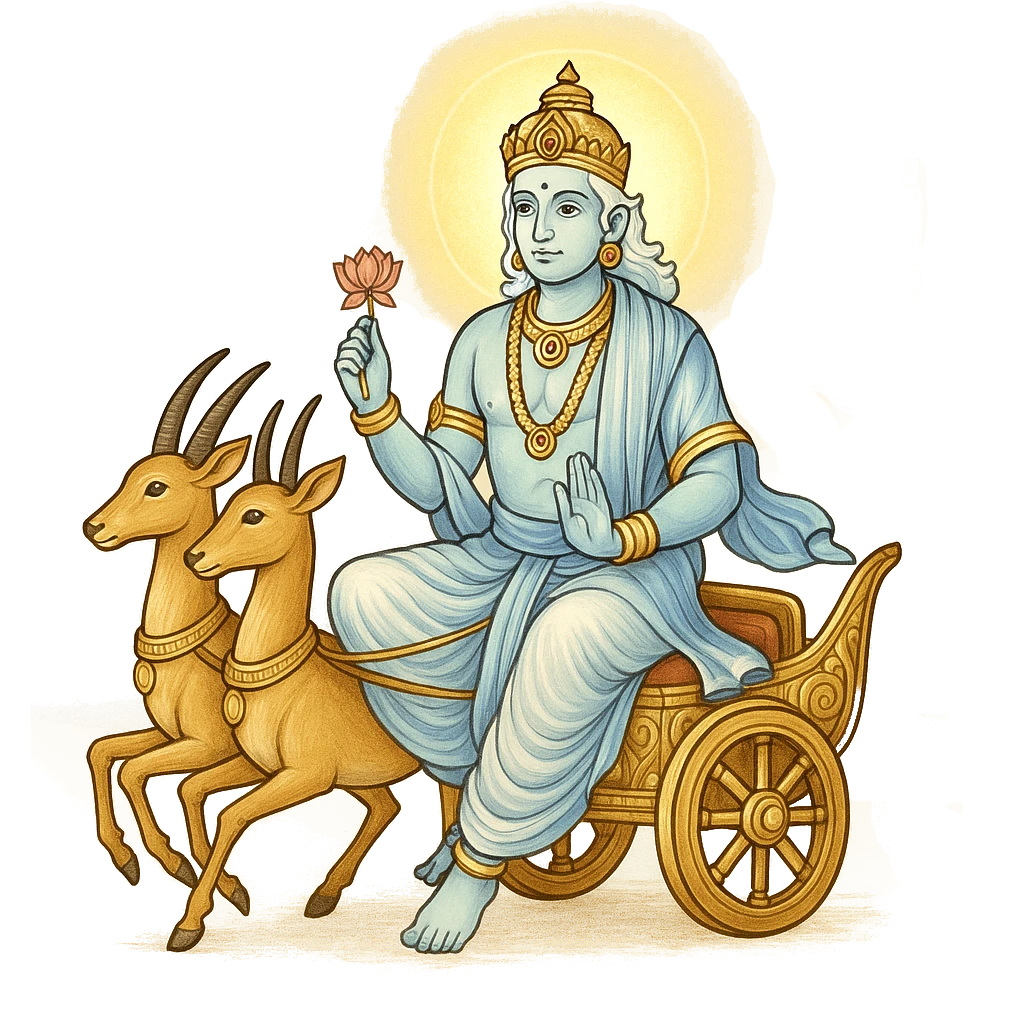
In Vedic cosmology and tantric ritual,
the moon is not merely an object in the sky — it is a conscious archetype.
Known as Chandra, the moon is the embodiment of mind (manas),
soma (nectar), and divine rhythmic intelligence.
Its phases mark not just time but energy patterns that affect body, mind, and spirit.
Gayatri, as the luminous goddess of inner light,
has a subtle but profound relationship to the moon.
Though her brilliance is solar in origin (Savitur),
her movement through the psyche, intuition, and subtle body is unmistakably lunar.
This chapter explores how the phases of the moon influence Gayatri practice,
feminine sādhanā, mantra power, and inner growth.
Chandra – The Reflective Mind and Nectar of Awareness
In Vedic symbolism, Surya (sun) represents consciousness,
and Chandra (moon) represents the mind — reflective, cyclical, intuitive.
Chandra governs:
Rasa (essence and taste)
Soma (divine nectar of immortality)
Intuition, dreams, receptivity
The left channel (iḍā nāḍī) — the cooling, feminine current
Gayatri’s work in the psyche is best understood not as a floodlight, but as moonlight:
Subtle
Soothing
Layered
Cyclical
Just as the moon waxes and wanes, inner realization moves in spirals, not lines.
The Lunar Month and Mantric Energy
A full lunar month (Chandra Māsa) has 30 tithis (moon days), divided into two halves:
Śukla Pakṣa (Waxing Moon) – Light increases
Ideal for manifestation, learning, japa, creative sādhanā
Each day builds momentum toward fullness
Kṛṣṇa Pakṣa (Waning Moon) – Light decreases
Ideal for cleansing, shadow work, ego dissolution, silent mantra
Each day refines and contracts energy inward
Each tithi holds a specific energetic flavor, and ancient practitioners attuned their mantra work accordingly.
Mapping Gayatri Practice to the Moon Phases
New Moon (Amāvasyā)
Deep inward silence
Excellent for mantra in seed form (bīja)
Visualize Gayatri as potential light
Waxing Crescent to Full Moon
Build mantra repetitions gradually
Focus on manifesting insight, clarity, creativity
Chant aloud, visualize expansion
Full Moon (Pūrṇimā)
Height of psychic power
Ideal for Gayatri fire rituals, japa circles, water charging
Chant with full devotion — see her as the moon itself
Waning Moon
Internalize practice
Whisper, then mentally repeat Gayatri
Journal insights, let go of identities
Dark Moon (Amāvasyā)
Rest
No chanting unless in complete silence
Absorb — the mantra lives inside you
Feminine Timing and Lunar Sādhanā
For women, lunar wisdom is encoded in menstrual rhythms:
New moon bleed: inward, intuitive, cleansing
Full moon ovulation: radiant, expressive, creative
Ancient yoginīs aligned their mantra, meditation, and ritual with their cycle of shakti.
Gayatri is especially powerful when her light is welcomed in harmony with the womb’s phases.
For men, working with the moon opens intuitive intelligence:
Dream journaling
Receptive meditation
Embracing yin energy
Soma, Bindu, and Gayatri’s Nectar
The soma of the moon is stored in the bindu (crown point) in yogic anatomy.
When Gayatri is chanted with devotion:
Soma begins to drip from the bindu
It flows through the iḍā nāḍī, cooling and calming the mind
It reaches the heart, feeding devotion
Gayatri is not only a mantra — she is a moonbeam that becomes soma.
Her syllables stimulate the inner lunar nectar.
Practices for Lunar Integration
Lunar Arc Japa
Begin at New Moon
Add 4 extra rounds of Gayatri each day until Full Moon
Then decrease 4 rounds per day to New Moon
Creates a 30-day energetic wave
Moon-Gazing and Mantra
Sit under moonlight
Chant Gayatri silently while absorbing the light
Let her face appear in the moon
Water Charging with Moonlight
Fill a vessel with water
Leave under moonlight
Chant Gayatri 108 times
Drink for soma integration
Dream Sādhanā
Before sleep on waxing moons, chant softly
Ask Gayatri to teach you in dreams
Record dreams as transmissions
Final Insight: The Moon is the Mirror
Gayatri may shine like the sun, but her wisdom flows like the moon.
She reflects what you are ready to see, softens what feels too harsh,
and teaches that time is not a race, but a rhythm.
To walk with her by the moon:
Is to honor your inner tides
To welcome silence as instruction
To let mystery unfold
The moon is not darkness. It is gentle illumination.
And Gayatri is its voice.
About
This website arose from a deep fascination with Gayatri.
Not only the mantra, but the living cosmology around it.
The deities, the symbols, the rays of meaning.
In exploring Vedic teachings and South Indian tantric traditions,
I began to see many paths pointing to the same light.
This page gathers those insights in one place.
Devas and their attributes. Inner and outer meanings of the mantra.
Different angles, one luminous source.
Here you will find two forms of the Gayatri Mantra:
the original Vedic version, and a South Indian tantric rendering.
Both are shared through the Surya player, with visual depictions and real-time English meaning.
The aim is not to replace any tradition.
It is to honour them, side by side, as facets of one great radiance.
All of this is offered freely, for anyone who is drawn to Gayatri.
If this project supports your journey, please consider helping it grow.
Donations keep the site alive, and allow new ideas and tools to be brought into form.
May this work, in whatever small way, honour Gayatri and bless all who visit here.
Disclaimer
This project is a personal offering, not an official voice for any lineage or institution.
The aim is to approach Gayatri with as much respect and care as possible.
To listen to different traditions, and to honour their insights.
The perspectives shown here draw from multiple streams.
Vedic. South Indian tantric. And related teachings on Gayatri and the devas.
Each view is true from its own angle, time, and cultural setting.
This site does not claim to be complete, final, or perfect.
It is a work in progress, offered in good faith.
If you see places where the wording could be clearer, or the explanations more accurate,
or if you wish to share helpful insights from your own tradition,
please contact me through the Suggestions tab at the bottom of this page.
I will do my best to listen, to learn, and to make amendments where needed.
The intention is a fair and loving portrayal of Gayatri, her mantra, and her many traditions.
Thank you for your understanding, and for approaching this material with the same respect.
Suggestions
This project is still growing, and your feedback is welcome.
If you have thoughts about the design, the wording, or the overall aim of this site,
I would be grateful to hear them.
You may suggest improvements, point out unclear parts, or share corrections from your own understanding or tradition.
Ideas for new features, visual tools, or related Gayatri material are also very welcome.
All sincere feedback will be read with care, and appreciated.
Please send your suggestions to:
info@gayatri.uk
Donate
This Gayatri project has been created with care and devotion, by a single person.
Every image, every line of text, every small detail, has been shaped slowly over time.
The aim is simple: to honour Gayatri, and to share fresh light on these ancient traditions.
All of this is offered freely. There is no paywall, and no required payment.
If this page has touched you, helped you, or deepened your connection with Gayatri,
please consider supporting this work.
Your donation helps this page stay online, and allows new projects and pages to grow alongside it.
It also makes it possible to create more visual tools, more explanations, and more ways to explore these teachings.
Any amount is appreciated. Large or small, it is received with gratitude.
Thank you for considering a donation, and for helping this Gayatri offering continue to unfold.
Legal
Copyright © AGS. All rights reserved.
The design, layout, structure, visual presentation, functionality, and written content of this Gayatri page/application are the creative work and intellectual property of AGS and are protected under applicable copyright laws.
This Gayatri page is offered freely for personal, non-commercial use.
We kindly ask that the design, code, and content not be reproduced, modified, redistributed, or used for commercial purposes without prior written permission.
If you are interested in commercial use, organizational implementation, or commissioning a customized version of this page/application with personalized content boxes, we would be pleased to discuss licensing and collaborative arrangements.
If you would like to support the continued development of this page and future enhancements, you are warmly invited to use the Donate option or the Suggestions form at the bottom of this page for correspondence.
What Treasure waits to be Rediscovered?
Solve the Mystery of the 10 Mahavidyas Puzzle to Unlock Their True Meaning
In Vedic cosmology and tantric ritual,
the moon is not merely an object in the sky — it is a conscious archetype.
Known as Chandra, the moon is the embodiment of mind (manas),
soma (nectar), and divine rhythmic intelligence.